Article: Best Types of Beds for Every Bedroom and Sleeping Style
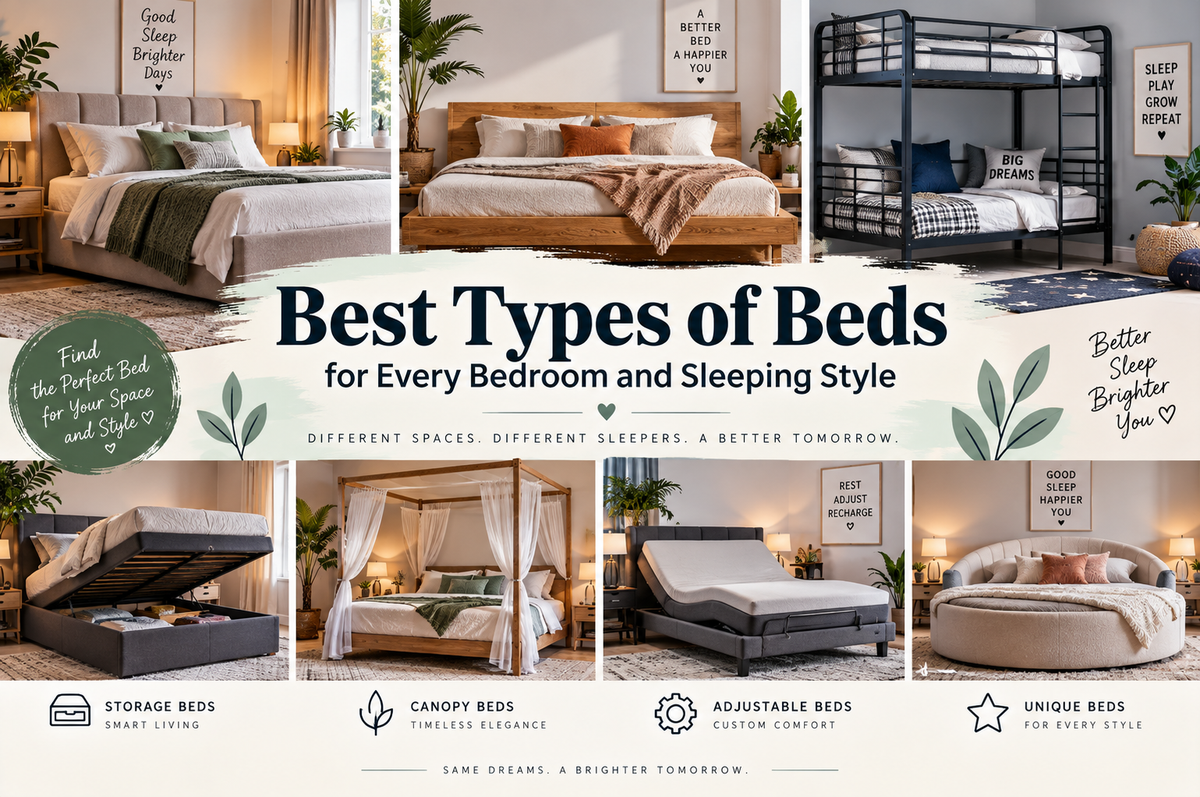
Best Types of Beds for Every Bedroom and Sleeping Style
Choosing a bed sounds simple until you start looking. Divan or ottoman? Upholstered or practical? Double or king size? And does the type of bed you choose actually make a difference to the way you sleep?
It can.
The best bed is one that works on three levels at once: it fits your bedroom, suits the way you use the space and provides the right foundation for your mattress and sleeping style. A beautiful statement bed that overwhelms a small bedroom is no bargain. Nor is a compact bed that leaves two sleepers fighting for space every night.
The quick answer: For most bedrooms, start with the largest sensible bed size that still leaves comfortable walking space around the room. Choose an ottoman or divan bed when storage matters, an upholstered bed when comfort and bedroom style are priorities, and consider an adjustable electric bed when personalised positioning is important. Couples generally benefit from more sleeping width, while side, back and stomach sleepers should pay particularly close attention to mattress firmness and support. The bed frame and mattress need to work as a pair rather than being chosen in isolation.
This guide looks beyond appearances to compare the different types of beds available, where each one works best and what to consider for different bedrooms and sleeping habits.
What Type of Bed Should I Buy?
There isn't one bed type that is automatically best for everybody.
The right choice depends on a surprisingly practical combination of bedroom size, storage requirements, sleeping position, mattress choice, personal comfort and bedroom décor.
Before choosing a bed, ask yourself:
- How much room do I really have? Measure the bedroom rather than estimating it by eye.
- Who will sleep in the bed? A solo sleeper, couple, child and occasional guest all have different requirements.
- Could the bed solve a storage problem? In a smaller room, hidden storage can be more valuable than another chest of drawers.
- How do I sleep? Side sleepers, back sleepers, stomach sleepers and combination sleepers can have different mattress support requirements.
- How do I use the bed when I'm awake? Reading, watching television or sitting upright may influence the type of bed and headboard you prefer.
- What mattress will sit on it? Mattress size, support and compatibility should be considered alongside the bed base.
- How important is the bed to the look of the room? In a master bedroom especially, the bed is usually the visual centrepiece.
Get those decisions right and choosing between the many types of bed frames becomes much easier.
First, Choose the Right Bed Size for the Bedroom
Before comparing a divan bed with an ottoman or debating headboard styles, establish how much physical space you can give to the bed.
This is where a tape measure beats guesswork every time.
Measure the usable floor space, note the position of doors, radiators, wardrobes and windows, and remember to account for drawers or cupboards that need room to open. The bed dimensions themselves are only part of the equation; you also need enough walking space for the bedroom to feel comfortable.
A larger bed isn't necessarily a better bed if you have to turn sideways to get around it.
Matching bed size to the room
A single bed can make sense for a child's bedroom, compact guest bedroom or solo sleeper where conserving floor space is important. A small double bed can provide extra sleeping width without demanding the footprint of a full double, making it useful in some smaller bedrooms.
The double bed remains a versatile choice for couples and solo sleepers who enjoy more space. Where the room allows it, a king size bed gives two sleepers additional personal sleeping space, while a super king bed can make a generous master bedroom feel properly proportioned.
Think about the relationship between bed size and room size rather than looking at mattress dimensions alone.
| Bedroom situation | Bed size/type to consider | Why it can work |
|---|---|---|
| Compact child's room | Single bed | Preserves valuable floor space |
| Small guest bedroom | Single or small double | Balances sleeping space with room to move |
| Standard double bedroom | Double bed | A versatile everyday size |
| Main bedroom for a couple | Double or king size | More room can improve personal sleeping space |
| Large master bedroom | King or super king | Makes better use of a generous room |
| Bedroom short on storage | Divan or ottoman bed | Combines sleeping and storage space |
These aren't rigid rules. Bedroom shape matters just as much as its total area. An awkward alcove, sloping ceiling or narrow walkway can change what will comfortably fit.
1. Upholstered Beds: Best for Comfort and Bedroom Style
An upholstered bed is an excellent starting point when you want the bed to feel like a deliberate piece of furniture rather than simply somewhere to put a mattress.
Fabric-covered frames and upholstered headboards introduce softness to a bedroom full of hard surfaces. Depending on the design, they can suit contemporary, minimalist and more traditional bedroom décor alike.
They're particularly appealing in a main bedroom or master bedroom, where the bed often becomes the room's visual focal point.
Why choose an upholstered bed frame?
The attraction isn't purely decorative.
A padded headboard can provide a more comfortable surface when sitting upright to read, relax or watch television in bed. That's worth considering if the bed doubles as your favourite place to wind down at the end of the evening.
An upholstered bed can be a strong choice when you want:
- a softer, more inviting bedroom style;
- a comfortable headboard for sitting upright;
- a statement bed for a main bedroom;
- fabric texture to complement existing bedroom décor;
- a contemporary alternative to a wooden or metal bed frame.
The trade-off is maintenance. Fabric naturally requires a different kind of care from timber or metal, particularly in busy family homes or rooms shared with pets.
Best suited to: main bedrooms, master bedrooms, contemporary bedrooms and sleepers who regularly sit up in bed.
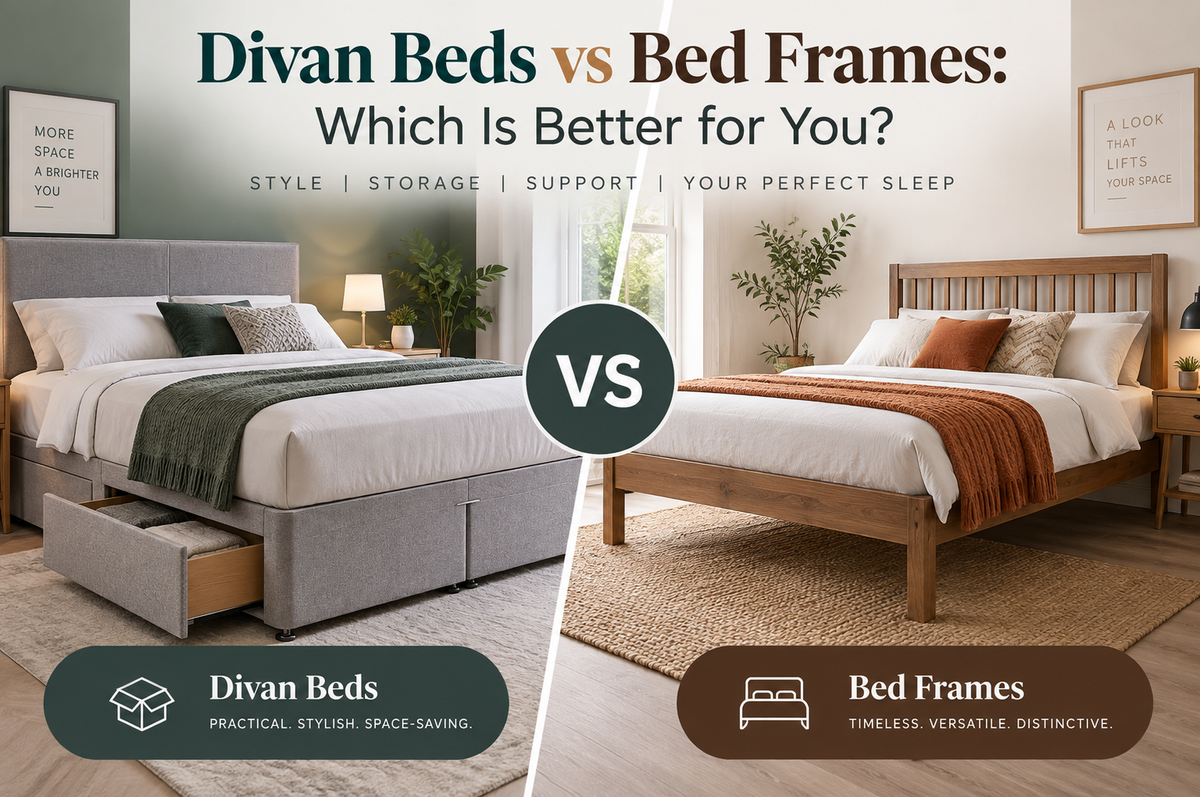
2. Divan Beds: Best for Practical, Flexible Bedrooms
Sometimes the smartest bed is the one that quietly gets everything right.
Divan beds are a practical option because the base sits beneath the mattress without the wider external framework found on many traditional bed frames. That can make efficient use of the available bedroom floor space.
A divan base can also provide a clean foundation for the mattress while offering different storage configurations depending on the design.
That combination makes the divan particularly useful when you're choosing a bed for an everyday bedroom where space, simplicity and storage matter as much as visual drama.
Who is a divan bed best for?
Consider one for:
- a bedroom where every centimetre of usable space matters;
- a guest bedroom that needs to remain uncluttered;
- a main bedroom where built-in storage would be useful;
- sleepers who prefer a neat, understated bed base;
- rooms where you want to choose the headboard separately.
Storage options are especially important. Drawers built into the base can create useful space for bedding, spare sheets, clothing or other items without adding another piece of furniture to the room.
For a small bedroom, that can change the entire layout.
Instead of squeezing a large chest of drawers beside the bed, you can make the footprint you're already using work harder.
3. Ottoman Beds: Best for Maximum Hidden Storage
If bedroom storage is the problem you really need to solve, an ottoman bed deserves serious consideration.
Rather than relying solely on individual storage drawers, an ottoman bed typically allows the mattress platform to lift so that a substantial area inside the bed base can be used for storage.
That's valuable because a bed already occupies a large percentage of the floor in most bedrooms. An ottoman turns some of that otherwise unused volume into hidden storage.
In a small bedroom, the most useful furniture often isn't smaller furniture — it's furniture that performs more than one job.
This is why an ottoman storage bed can be particularly effective in a compact bedroom, apartment bedroom, spare bedroom or anywhere you need to maximise bedroom space.
Bulky bedding, spare duvets, pillows, seasonal clothing and other less frequently used items can disappear beneath the mattress rather than taking over wardrobes and cupboards.
Divan vs ottoman bed: what's the difference?
Both can provide storage, but they solve the problem differently.
A divan bed with storage drawers gives you compartmentalised storage that can be accessed without lifting the mattress platform. An ottoman storage bed prioritises a larger concealed storage area beneath the sleeping surface.
Your bedroom layout may decide the winner.
If bedside furniture or a wall would prevent drawers from opening comfortably, lift-up storage can be particularly useful. If you frequently need quick access to smaller items, drawers may be more convenient.
So rather than asking “Is an ottoman better than a divan?”, ask:
“Which storage system works with the space around my bed?”
That question usually leads to a much more useful answer.
4. Adjustable and Electric Beds: Best for Personalised Positioning
Not everyone wants to sleep completely flat, and not everyone uses a bed purely for sleeping.
Electric beds introduce another consideration: adjustable positioning.
Depending on the particular bed and mattress combination, an adjustable bed can allow sections of the sleeping surface to be raised or lowered. That makes it possible to change your position for sleeping, resting, reading or watching television.
For someone who spends significant time sitting upright in bed, that flexibility can be considerably more useful than choosing a conventional frame purely because of its appearance.
The important point here is compatibility.
An adjustable bed needs an appropriate mattress, so mattress and bed frame should be considered together. Don't assume that an existing mattress will automatically be suitable for an adjustable base.
Does your sleeping position determine your bed type?
Only partly.
This is an area where bed-buying advice can become confusing because bed type and mattress type are not the same thing.
Your sleeping position generally has a much more direct relationship with the mattress firmness, pressure relief and body support you need than with whether the outer bed is upholstered, divan or ottoman.
For example:
- Side sleepers often pay particular attention to pressure relief around the shoulders and hips.
- Back sleepers generally need balanced support that helps maintain a comfortable sleeping posture.
- Stomach or front sleepers may prefer a sleeping surface that prevents excessive sinking.
- Combination sleepers need comfort across several positions and enough freedom to change position easily.
- Couples need to consider the requirements of two sleepers, which may make bed size and personalised comfort particularly important.
That means choosing the right bed should be a two-part decision:
Choose the bed for the room and the way you live; choose the mattress for the way you sleep.
The two then need to work together as one sleep system.
5. TV Beds: Best for Bedrooms Made for Switching Off
For some people, the bedroom is strictly for sleeping. For others, it's also the place to watch a film, catch up on a series or enjoy a slow Sunday morning.
That's where TV beds come into their own.
A TV bed incorporates space for a television within the bed design, typically allowing the screen to remain concealed when it isn't being used. Instead of mounting a television on the wall or finding room for additional furniture at the foot of the bed, the technology becomes part of the bed itself.
The result can be a cleaner, less cluttered bedroom.
Who should consider a TV bed?
A TV bed makes most sense for someone who:
- regularly watches television from bed;
- wants to reduce visible technology in the bedroom;
- doesn't want a television permanently mounted on the wall;
- has enough room for a substantial statement bed;
- wants sleeping and entertainment functions combined in one piece of furniture.
This tends to make TV beds particularly well suited to a main bedroom or larger bedroom, where their proportions can sit comfortably within the available space.
Room measurements matter, though. Don't judge suitability from mattress size alone. Check the complete bed frame size, including the foot end, and make sure there is still comfortable walking space around the bed.
In a small bedroom, every centimetre matters. In a generous bedroom, a larger bed can actually help the space feel better proportioned.
6. Zip and Link Beds: Best for Flexible Sleeping Arrangements
Sometimes the question isn't simply “What size bed do I need?”
It's “What size bed might I need next week?”
A zip and link bed offers flexibility by allowing separate sleeping sections to be configured together or individually, depending on the particular model.
That versatility can be especially valuable in a guest bedroom, where different visitors may have completely different requirements.
One week, the room may be used by a couple. Another week, it may need separate sleeping spaces.
Rather than dedicating the bedroom permanently to one arrangement, a flexible bed gives the room more than one purpose.
A particularly useful choice for guest bedrooms
Think about how spare bedrooms are actually used.
They're often expected to accommodate:
- couples;
- individual adult guests;
- relatives staying for several nights;
- friends who don't want to share a sleeping surface;
- changing household requirements over time.
A fixed double bed solves only some of those scenarios.
A flexible sleeping arrangement can solve considerably more.
This makes adaptability an important part of choosing the best bed for guests. Comfort still matters, of course, but versatility can determine how useful the entire room becomes.
A good guest bedroom doesn't need to predict who will stay next. It needs to be flexible enough that it doesn't have to.
7. Children's Beds: Best for Growing Bedrooms
Choosing a bed for a child's room brings a completely different set of priorities.
Adults may focus heavily on bedroom style, mattress comfort or luxurious proportions. In a children's bedroom, practical questions about usable floor space, storage and how the room will change as the child grows become equally important.
The range of children's beds is therefore worth considering in the context of the entire room rather than the sleeping area alone.
A child's bedroom may need to function as somewhere to:
- sleep;
- play;
- read;
- get dressed;
- store toys and clothes;
- complete homework;
- spend time with friends.
That's a lot to ask from one room.
Choosing a bed for a small child's bedroom
Start with measurements.
A single bed will often be the natural choice, but the external dimensions of the frame still matter. Two beds designed for the same mattress size can occupy different amounts of floor space.
Then look at what happens underneath and around the bed.
Under-bed storage can be extremely useful for toys, spare bedding and seasonal clothes. In a compact room, a storage bed may reduce the need for additional furniture and leave more open floor space for everyday use.
This is also why space-saving formats such as a cabin bed, mid sleeper or high sleeper can be attractive in appropriate circumstances. By making use of vertical space, these designs can potentially free up room underneath for storage, a desk or another practical function.
For shared bedrooms, bunk beds can make efficient use of floor space, while a trundle bed can provide an additional sleeping surface for occasional use.
Suitability and safety should always be considered for the individual child and the specific bed design, particularly with raised sleeping platforms.
8. Guest Beds, Sofa Beds and Daybeds: Best for Rooms That Have Two Jobs
Not every home has the luxury of a dedicated spare bedroom.
The "guest room" may actually be an office Monday to Friday, a hobby room most of the year or a small box room that occasionally needs to accommodate an overnight visitor.
In those circumstances, a conventional permanent double bed can consume a lot of valuable space for something that's only used occasionally.
This is where alternative types of beds become useful.
Sofa beds
A sofa bed allows a room to function as living or seating space most of the time and become a sleeping area when required.
It's a particularly logical solution for:
- home offices;
- multifunctional spare rooms;
- studio spaces;
- occasional guest accommodation.
The compromise is that a sofa bed has two jobs to perform. If it will be used for sleeping frequently, don't treat mattress comfort as an afterthought.
Daybeds
A daybed sits somewhere between seating and sleeping furniture.
Its appearance can make it easier to integrate into a home office, reading room or teenager's bedroom without making the space feel permanently arranged around a bed.
Add cushions during the day and it can feel more like seating. Remove them at night and the sleeping surface is ready to use.
Trundle beds
A trundle bed hides an additional sleeping surface beneath another bed and pulls out when needed.
That can make it an efficient choice for children's bedrooms, teenage bedrooms and guest spaces where a second sleeping position is useful occasionally but doesn't justify sacrificing permanent floor space.
These three options illustrate an important principle:
The best bed for a room isn't necessarily the bed that provides the most sleeping space. It's the bed that allows the room to perform all of its required functions.
9. Bunk, Cabin, Mid Sleeper and High Sleeper Beds: Best for Making Use of Height
Most bed-buying decisions focus on width and length.
Small bedrooms often benefit from thinking vertically as well.
A bunk bed stacks sleeping spaces. A cabin bed can incorporate useful storage around or beneath the sleeping area. Mid and high sleepers raise the mattress so that the floor underneath can potentially perform another function.
That distinction matters in a compact kids' bedroom.
Imagine a room where a conventional single bed, wardrobe, drawers and desk would consume almost all of the usable floor area. Raising the sleeping surface can potentially give part of that footprint back.
Depending on the particular design, the space underneath might accommodate:
- drawers or cupboards;
- shelving;
- a desk;
- a reading area;
- toy storage;
- open floor space.
Ceiling height becomes an important measurement here. So does the child's age and the suitability of the individual product.
This is one occasion where simply buying the largest bed that fits the floor plan is clearly not the answer.
10. Murphy Beds and Folding Beds: Best for Occasional Sleeping Space
A Murphy bed, sometimes called a wall bed, takes the space-saving principle further by allowing the sleeping surface to be stored vertically when it isn't required.
A folding bed tackles a similar problem in a more portable way.
Neither format is necessary for the average main bedroom, but both belong in a complete discussion of different types of beds because they solve a very specific problem:
How do you provide somewhere to sleep without permanently turning the room into a bedroom?
That makes them relevant to very small homes, apartment bedrooms, home offices and occasional guest spaces.
There are compromises. Installation, mattress compatibility, available wall space, comfort and frequency of use all need consideration.
But where floor space is more valuable during waking hours than sleeping hours, a convertible bed can be a logical solution.
11. Four-Poster, Canopy and Statement Beds: Best for Large Bedrooms
Space-saving isn't always the goal.
Sometimes a bedroom is large enough that a small or visually lightweight bed feels lost in it.
A four-poster bed, canopy bed, tall upholstered bed or other statement design can give a large master bedroom a stronger focal point and help establish the scale of the room.
These designs work particularly well when the bed is intended to anchor the bedroom décor rather than disappear into it.
Before choosing one, consider:
Ceiling height. Tall posts and substantial headboards need enough vertical space around them.
Room proportions. A statement bed needs visual breathing room. Crowding it between wardrobes and walls defeats much of the effect.
Walking space. Generous proportions shouldn't make circulation awkward.
Bedroom style. Four-poster doesn't automatically mean traditional. Materials, fabric and silhouette can make the concept feel classic, minimalist or contemporary.
The same logic applies to a sleigh bed, tall tufted headboard or other visually substantial frame.
If a small bedroom benefits from furniture that works harder, a large bedroom often benefits from furniture with enough presence to belong there.
12. What Is the Best Bed for Couples?
For couples, size becomes much more than a question of whether two people technically fit on the mattress.
Each sleeper needs enough personal space to settle into a comfortable sleeping position, change position during the night and get in or out of bed without unnecessarily disturbing the other person.
Where the bedroom allows it, moving from a double bed to a king size bed or super king bed can provide more individual sleeping width.
But dimensions aren't the only consideration.
Couples should think about:
- Different sleeping positions. One person may be a side sleeper while the other sleeps predominantly on their back.
- Different comfort preferences. Mattress firmness that feels comfortable to one person may feel completely different to another.
- Movement. A restless sleeper can make motion across the sleeping surface more noticeable.
- Different routines. One person may read or watch television while the other wants to sleep.
- Storage. Two people generally means more clothes, bedding and belongings competing for the same bedroom storage.
- Bedroom proportions. A super king isn't an upgrade if it makes wardrobes inaccessible or leaves no comfortable walking space.
This is why the best bed for couples isn't automatically the biggest or most expensive one.
It's the bed and mattress combination that best accommodates two sets of needs within the room available.
Bed Type vs Mattress Type: Don't Confuse the Two
This distinction is important enough to repeat.
An ottoman bed doesn't inherently make someone a better side sleeper. An upholstered bed isn't automatically better for a bad night's sleep than a metal or wooden bed frame. And buying a visually impressive king size bed doesn't guarantee better comfort if the mattress isn't right.
The bed frame or bed base determines factors such as dimensions, storage, bedroom functionality, style and the foundation beneath the mattress.
The mattress has a more direct influence on qualities such as firmness, pressure relief and the way your body feels supported.
Those decisions overlap, but they aren't interchangeable.
A memory foam mattress, pocket sprung mattress, hybrid mattress or other mattress type should be selected with its intended base and your individual requirements in mind. Likewise, check mattress compatibility before pairing a mattress with an unusual or adjustable bed base.
Side sleepers
Side sleepers commonly focus on a balance between pressure relief and support, particularly around areas such as the shoulders and hips.
Back sleepers
Back sleepers generally want a mattress that provides comfortable, balanced support without allowing the body to sink excessively.
Stomach or front sleepers
People who sleep predominantly on their front may pay particular attention to mattress firmness and how much the body sinks into the sleeping surface.
Combination sleepers
A combination sleeper changes position during the night, so freedom of movement and comfort across more than one position become especially relevant.
Your personal preference still matters. Terms such as soft mattress, medium mattress and firm mattress describe useful categories, but they don't eliminate individual differences in body shape, weight and comfort.
That leads to one of the most useful rules in this entire bed buying guide:
Your bedroom helps determine the bed. Your body helps determine the mattress. The best sleep setup is where those two decisions meet.
So, Which Bed Is Right for Which Bedroom?
At this stage, the choice starts becoming clearer.
For a small bedroom, prioritise efficient dimensions and consider storage that makes the existing bed footprint work harder.
For a master bedroom, you may have more freedom to choose a larger mattress size, substantial upholstered headboard or statement frame.
For a guest bedroom, flexibility may matter more than making a dramatic design statement.
For a children's bedroom, consider how sleeping, storage, playing and studying all compete for the same floor space.
And for a multifunctional room, don't assume that a conventional permanent bed is the only answer. A daybed, trundle, sofa bed, folding bed or wall bed may make considerably better use of the room.
The next step is bringing all of those choices together: bed materials, bases, headboards, storage systems, mattress compatibility, measurements and the practical checklist that helps you avoid buying the wrong bed.
How to Choose a Bed Frame Material
Once you've narrowed down the type and size of bed you need, there's another decision waiting: what should the bed actually be made from?
Material affects far more than appearance. It influences the overall bedroom style, maintenance, durability and even how visually substantial the bed feels in the room.
The familiar choices include a wooden bed frame, metal bed frame and upholstered bed frame, but there are plenty of variations within each category.
Wooden bed frames
Wood brings natural texture and warmth into a bedroom.
A solid wood bed can work particularly well in traditional, rustic and Scandi-inspired interiors, although cleaner silhouettes can look equally at home in a modern bedroom.
Oak, pine and other timber finishes can produce very different effects. A substantial oak bed might become a strong focal point, while a simple solid pine bed can feel lighter and more understated.
Wood is also relatively easy to coordinate with other bedroom furniture.
Metal bed frames
A metal bed can range from an ornate iron-inspired frame to a minimalist steel bed frame.
That versatility makes metal suitable for everything from traditional bedrooms to industrial and contemporary interiors.
Visually lighter metal frames can also be useful where you don't want the bed to dominate the room. The open construction of some designs creates a greater sense of visible floor space than a bulky enclosed base.
Upholstered bed frames
Fabric changes the character of a bed completely.
Velvet can create a rich, luxurious appearance, while more understated fabric or linen-style upholstery can feel softer and more relaxed. Faux leather offers another distinctive finish.
The main consideration is care. Unlike a hard wooden or metal surface, fabric may require regular vacuuming and more attention to marks or spills.
Whichever material you prefer, don't choose it in isolation.
Ask how the bed will look alongside the flooring, wardrobes, bedside furniture, curtains and overall bedroom décor. The bed is usually the largest individual piece of furniture in the room, so its texture and proportions carry considerable visual weight.
What Type of Bed Base Is Best?
Look beneath the mattress and you'll find one of the less glamorous — but more important — parts of choosing a bed.
The base.
Different designs can use a divan base, platform base, solid slats or sprung slats, and the construction beneath your mattress may influence how the complete sleep setup performs.
Slatted bases
A slatted base supports the mattress across a series of horizontal slats.
Solid slats provide a relatively fixed foundation. Sprung slats have some flexibility and can respond differently under load.
Slatted construction can also leave space beneath the mattress for airflow and ventilation.
However, mattress requirements vary. Slat spacing and the overall construction of the bed should be suitable for the mattress you're planning to use.
Platform and solid bases
A platform-style bed provides a more continuous supporting surface.
Again, compatibility matters. Don't assume that because a mattress physically fits within the frame, the combination is automatically suitable.
If you're replacing only one half of an existing bed-and-mattress combination, check the requirements before buying.
Think of the mattress and bed base as partners. A good mattress on an unsuitable base can be a poor combination, just as an excellent bed frame can't compensate for a mattress that doesn't suit the sleeper.
How Important Is the Headboard?
Very — if you use it.
A headboard can be decorative, practical or both.
For someone who gets into bed and immediately lies down, headboard design may be primarily an aesthetic decision. For someone who spends an hour reading each evening, it can become an important comfort feature.
An upholstered headboard provides a softer surface to lean against. A wooden or metal headboard can create a different visual effect but may feel firmer when sitting upright.
Then there's scale.
A tall statement headboard can give a large master bedroom a dramatic focal point, while a lower-profile design may feel more appropriate in a compact room or beneath a low ceiling.
Consider:
- headboard height;
- available wall space;
- ceiling height;
- upholstery and maintenance;
- whether you regularly sit upright;
- how the design works with your pillows;
- the proportions of the bed and bedroom.
Don't forget access either. A spectacular headboard isn't particularly helpful if its dimensions make getting the bed through a staircase or doorway unnecessarily difficult.
Storage Bed or Standard Bed: Which Should You Choose?
Storage is one of the biggest practical dividing lines between different types of beds.
If you have generous wardrobes, cupboards and drawers, you may prefer a more open bed frame and leave the area underneath largely unused.
If storage is already under pressure, the bed represents an enormous opportunity.
A bed with storage can potentially replace or reduce the need for other bedroom furniture. Depending on the design, storage might take the form of drawers, lift-up access or a larger concealed compartment beneath the mattress.
Choose built-in bed storage when:
- the bedroom is small;
- wardrobe space is limited;
- you need somewhere for spare bedding;
- seasonal clothing needs a home;
- adding another chest of drawers would make the room cramped;
- you prefer belongings to remain hidden.
Consider a standard frame when:
- you already have plenty of storage;
- you prefer a visually open bed;
- under-bed clearance contributes to the look you want;
- you want uncomplicated access beneath the frame;
- storage simply isn't a priority.
There's no prize for buying storage you don't need.
But in a small bedroom, hidden storage can be transformative because it uses space that's already occupied by the bed instead of claiming additional floor area.
How to Measure a Bedroom for a New Bed
One of the easiest bed-buying mistakes is measuring the mattress and assuming you're finished.
You're not.
A bed frame can extend beyond the mattress at the sides, head and foot. Headboards, footboards and upholstered surrounds can increase the total dimensions further.
Before ordering, measure the actual bedroom and compare those measurements with the complete external dimensions of the bed.
A practical bedroom-measuring checklist
- Measure the usable room width and length. Ignore areas permanently occupied by fitted furniture.
- Mark the proposed bed footprint. Painter's tape can help you visualise its real size on the floor.
- Check walking space. Imagine making the bed and moving around it every day.
- Open every door. Test the bedroom door, wardrobe doors, drawers and cupboards.
- Check radiators and windows. Make sure the frame or headboard won't obstruct anything important.
- Measure ceiling height where relevant. This matters particularly for tall headboards, four-poster designs and high sleepers.
- Consider bedside furniture. A bed may fit while leaving nowhere sensible for bedside tables.
- Measure the access route. Doorways, stairs, landings and tight corners matter when the bed is delivered.
There's a simple test worth applying here:
Don't ask only whether the bed fits. Ask whether the bedroom still works after the bed is in it.
That's the measurement that matters.
What Size Bed Do I Need?
The ideal bed size is the largest appropriate size that gives the sleeper enough room without compromising the usability of the bedroom.
For a compact room or child's bedroom, that may be a single bed. A small double can offer a middle ground where more sleeping width is desirable but space remains limited.
A double bed is a versatile option for many adult bedrooms, while king and super king sizes become increasingly attractive when two people share the sleeping surface and the room has enough space.
The key word is enough.
A larger mattress can give couples more personal sleeping space, but a bed that's too large for the bedroom can introduce daily annoyances: inaccessible drawers, narrow walkways, awkward doors and furniture squeezed into corners.
Bedroom design is a balancing act between sleeping space and living space.
Choosing a Bed for a Small Bedroom
Small bedrooms reward clever choices.
Start by questioning every piece of furniture that would otherwise occupy the floor. If the bed can provide bedroom storage, perhaps you don't need an additional chest of drawers. If a guest room only occasionally needs a second sleeping surface, perhaps that space doesn't need to be permanently occupied.
Look for:
- efficient external bed dimensions;
- integrated or under-bed storage;
- appropriate bed height;
- a headboard that doesn't overwhelm the room;
- unobstructed walking space;
- furniture that can perform more than one function.
Visually, lighter designs can sometimes make a compact bedroom feel less crowded, but practical use should come before appearance.
A beautiful minimalist frame doesn't solve much if you're then forced to stack spare bedding on top of the wardrobe.
Choosing a Bed for a Large or Master Bedroom
Large bedrooms create the opposite challenge.
Furniture that's too small can feel disconnected from the proportions of the room.
A generous king size or super king bed, substantial upholstered frame, tall headboard, sleigh bed or four-poster design can provide the visual weight a larger bedroom needs.
This is where bedroom style can play a greater role.
You might favour a classic bed in a traditional room, a low-profile bed in a minimalist interior or a statement upholstered design in a contemporary bedroom.
But don't fill space simply because it's available.
A larger room still benefits from clear circulation, balanced furniture placement and enough open floor area to feel calm.
Choosing a Bed for a Guest Bedroom
Guest rooms call for a different mindset.
You don't know exactly who will use the bed over the coming years, so flexibility is valuable.
Prioritise:
- broad comfort rather than highly individual preferences;
- appropriate mattress support;
- easy-to-use bedroom storage;
- enough space for visitors' belongings;
- flexible sleeping arrangements where useful;
- a bed size that doesn't overwhelm the spare room.
If the room doubles as an office or hobby space, versatility becomes even more important.
The best guest bed is rarely the most extravagant option. It's the one that makes visitors comfortable without preventing the room from being useful for the other 350-odd days of the year.
Choosing the Best Bed for Your Sleeping Style
By now, one distinction should be clear: sleeping style influences the mattress more directly than the decorative style of the bed frame.
A side sleeper doesn't necessarily need a different-looking bed from a back sleeper. They may, however, have different comfort and support preferences.
When evaluating your complete sleeping setup, consider these relationships:
| Sleeping style or lifestyle | What to prioritise |
|---|---|
| Side sleeper | Pressure relief, particularly around shoulders and hips |
| Back sleeper | Balanced, comfortable body support |
| Stomach/front sleeper | Appropriate firmness and support without excessive sinking |
| Combination sleeper | Ease of movement and comfort in multiple positions |
| Restless sleeper | Enough personal sleeping space and appropriate mattress construction |
| Couple | Width, individual comfort needs and movement |
| Solo sleeper | Personal comfort and room-appropriate bed size |
| Regular reader | Supportive headboard or adjustable positioning |
| TV watcher | Comfortable upright position and bedroom layout |
| Small-space sleeper | Efficient footprint and useful integrated storage |
| Guest | Versatility and broadly suitable comfort |
These are starting points rather than universal prescriptions. Mattress feel is personal, and factors such as body size, weight and individual preference can affect what feels comfortable.
Common Bed-Buying Mistakes to Avoid
By the time you've compared frames, fabrics, sizes and storage options, it's easy to become distracted by one feature and forget the bigger picture.
A few mistakes are particularly worth avoiding:
Buying by appearance alone
A bed can look spectacular online and still be completely wrong for the room.
Measure first. Fall in love with it second.
Choosing the biggest size that physically fits
“Fits” and “works” aren't synonyms.
Leave room to walk, open wardrobes, access drawers and make the bed comfortably.
Forgetting the external frame dimensions
A double mattress doesn't mean every double bed frame occupies exactly the same footprint.
Treating mattress and bed as separate purchases
Check mattress compatibility, base requirements and mattress size before committing to the complete setup.
Ignoring storage access
Drawer storage needs clearance at the side of the bed. Lift-up storage needs to be practical for the room and user.
Forgetting delivery access
Measure stairs, doorways and awkward turns before delivery day, not while the bed is sitting outside your house.
Choosing for today's room but not tomorrow's needs
Bedrooms change.
Children grow. Guest rooms become offices. Couples move house. Storage requirements increase. If two options work equally well now, flexibility and longevity can be useful deciding factors.
Bed Buying Checklist: 12 Things to Check Before You Order
Before making the final decision, run through this list:
- Have I measured the bedroom accurately?
- Have I checked the full bed frame dimensions, not just mattress size?
- Is there comfortable walking space around the bed?
- Can doors, wardrobes and drawers open normally?
- Is the bed appropriate for the person or people sleeping in it?
- Does the mattress size match the bed?
- Is the mattress compatible with the bed base?
- Do I need built-in or under-bed storage?
- Can that storage be accessed easily in this room?
- Does the headboard suit how I use the bed?
- Have I checked delivery and assembly access?
- Does the bed suit both my bedroom style and the way I actually live?
If you can confidently tick all twelve, you're much closer to choosing the right bed for the right reasons.
Frequently Asked Questions About Different Types of Beds
What is the best type of bed?
There is no single best bed type for every sleeper or bedroom. The ideal choice depends on room size, bed size, storage requirements, style, budget and how the bed will be used. Storage-focused bedrooms may benefit from ottoman or divan designs, while other rooms may place greater importance on upholstery, adjustability, flexibility or visual style.
What is the best bed for a small bedroom?
A compact bed with useful storage can be particularly effective in a small bedroom. Consider the external dimensions as well as mattress size, and look for opportunities to use the space beneath the bed rather than adding more furniture to an already crowded room.
Is an ottoman bed good for a small bedroom?
It can be. Lift-up storage makes use of the area beneath the mattress and can be particularly useful where there isn't enough clearance beside the bed for conventional storage drawers. Always check the individual bed dimensions and operating space.
Is a divan bed better than a bed frame?
Neither is universally better. A divan can provide an efficient footprint and practical storage options, while other bed frames may offer different aesthetics and features. The better choice is whichever suits your bedroom, mattress and priorities.
What type of bed is best for side sleepers?
For side sleepers, the mattress is generally more directly relevant than whether the outer frame is a divan, ottoman or upholstered bed. Consider mattress support and pressure relief alongside compatibility with the chosen bed base.
What bed is best for couples?
Couples should consider sleeping width, room size, mattress comfort, movement and each person's sleeping habits. Where space allows, a king or super king can provide more individual sleeping area than a double.
What is the best bed for a guest bedroom?
Look for comfort and versatility. The ideal solution depends on whether the guest room is permanently dedicated to visitors or also functions as an office, hobby room or other living space.
Should I buy a bed or mattress first?
It's often better to plan them together. The mattress needs to be the correct size and suitable for the bed base, while the bed itself needs to fit the bedroom. Treating them as a complete sleep setup helps avoid compatibility problems.
How much space should I leave around a bed?
There isn't one measurement that suits every bedroom. Leave enough practical clearance to walk around the bed where necessary, open doors and storage, access other furniture and make the bed comfortably.
Final Thoughts: The Best Bed Is the One That Fits Your Life
With so many different types of beds, it's tempting to search for a single winner.
There isn't one.
A compact children's bedroom and a large master bedroom don't need the same solution. Neither do a solo sleeper and a couple, or someone who wants maximum hidden storage and someone who wants an impressive statement bed.
The better approach is to narrow the decision in the right order:
Room first. Sleeper second. Mattress and support third. Style fourth.
Measure the bedroom and understand the usable floor space. Decide what size genuinely works. Think about storage and how the room functions during the day. Consider who sleeps there and their comfort requirements. Then choose the bed type, base, material and headboard that bring those needs together.
For some bedrooms, that means the simplicity of a divan. For others, the hidden capacity of an ottoman, the comfort and character of an upholstered frame, the flexibility of an adjustable design or a specialist bed that allows the room to perform more than one job.
The best bed for your bedroom isn't necessarily the biggest, softest, most elaborate or most fashionable.
It's the one that makes sense at midnight, at seven in the morning and every time you walk into the room in between.