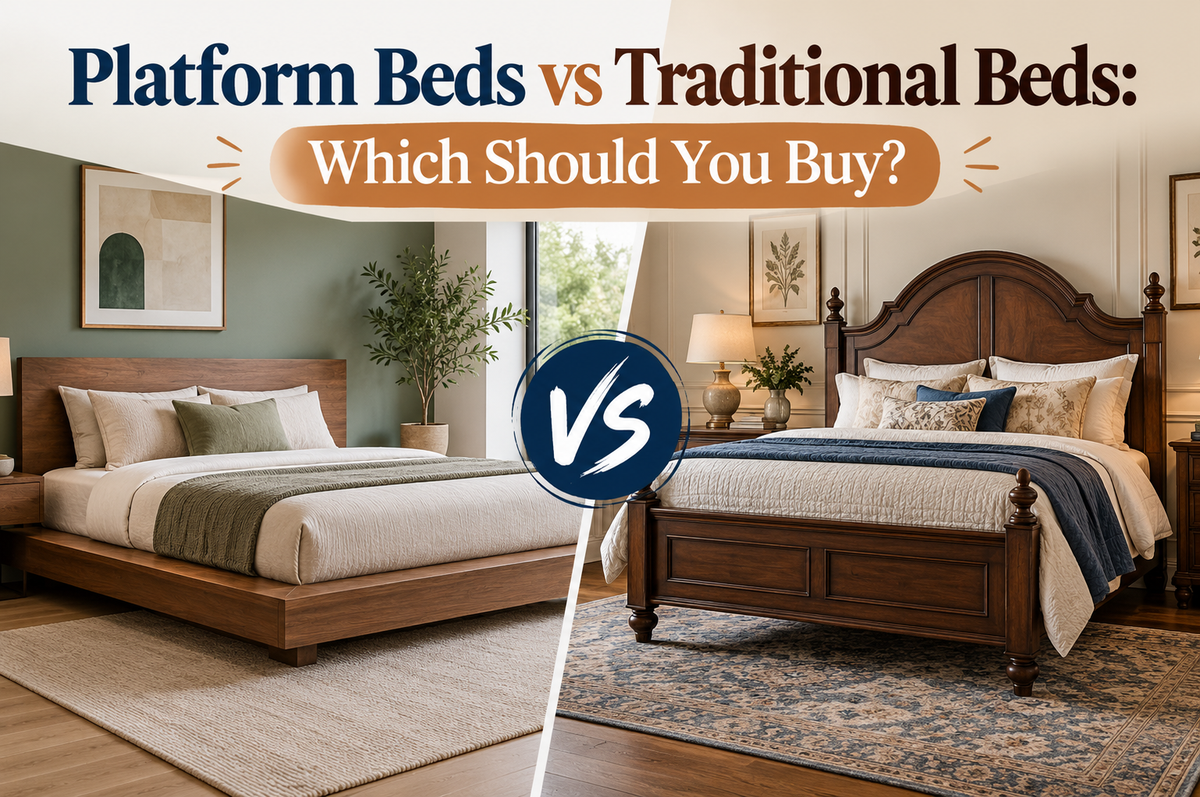
Platform Beds vs Traditional Beds: Which Should You Buy?
What Is a Traditional Bed?
“Traditional bed” is a much broader term.
It can describe a conventional bedstead consisting of a headboard, footboard, side rails and supporting base, or it can refer more generally to beds that use established base constructions rather than the low-profile platform style associated with many modern interiors.
A traditional bed frame may be wooden, metal or upholstered. It can be simple or decorative. It can sit relatively low or create a considerably more elevated sleeping position.
And this is where comparisons can become confusing.
A traditional-looking bed can still use modern slats. An upholstered bed can incorporate a platform-style support system. A contemporary bed can offer storage traditionally associated with divans.
In other words, appearance doesn't necessarily tell you what's underneath the mattress.
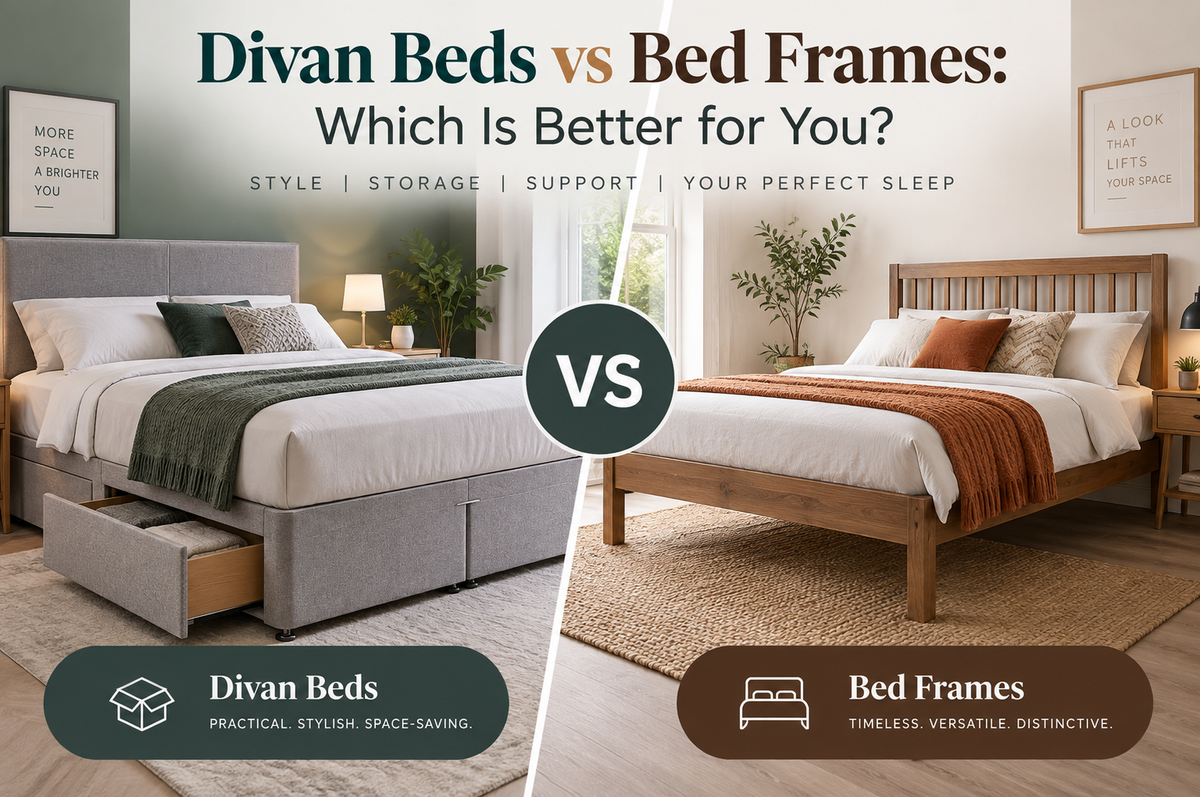
One familiar British alternative is the divan bed, where the supportive base forms a substantial part of the bed itself. Divans can create a different visual profile from an exposed-frame platform bed and can also incorporate storage within the base.
So rather than treating “platform” and “traditional” as two rigid categories, it is more useful to compare their construction, support and everyday practicality.
Platform Bed vs Traditional Bed at a Glance
| Feature | Platform bed | Traditional bed |
|---|---|---|
| Mattress support | Usually directly supported by slats or a solid base | Depends on frame/base construction |
| Box spring | Generally unnecessary | May be used in designs intended for one |
| Bed height | Often lower profile | Frequently higher, although designs vary |
| Appearance | Clean, contemporary, minimalist | Can range from understated to decorative |
| Mattress compatibility | Broad, subject to manufacturer requirements | Depends on the supporting base |
| Storage | Varies by design | Varies; divan and ottoman styles can provide substantial storage |
| Number of components | Often fewer | Can involve separate frame/base components |
| Assembly | Frequently straightforward, but design dependent | Varies substantially |
| Bedroom suitability | Particularly appealing in modern and compact spaces | Extremely versatile across interior styles |
There are exceptions in virtually every row, which is why buying based purely on a product label is rarely a good idea.
The construction underneath the mattress deserves more attention.
The Biggest Difference: How Your Mattress Is Supported
Strip away the upholstery, colours and styling and this is the heart of the platform bed vs traditional bed comparison.
Your mattress needs a stable foundation.
Without appropriate bed frame support, weight may not be distributed as intended. Over time, unsuitable support can potentially affect mattress stability, comfort and longevity. The exact requirements depend on the mattress manufacturer, which is why checking mattress support and warranty requirements before buying a new frame is sensible.
Platform beds solve this through an integrated supporting surface.
Slatted platform bases
A slatted base uses parallel slats extending across the width of the bed. These may be solid wooden slats or sprung slats, depending on the construction.
Slats have several practical advantages. They can provide:
-
Direct and evenly distributed mattress support
-
Air circulation beneath the mattress
-
A lighter structure than some solid bases
-
Straightforward access to individual components
-
A relatively simple overall bed construction
The gaps between the slats also encourage mattress ventilation. Airflow underneath a mattress can be useful because heat and moisture naturally accumulate during sleep.
But slat spacing matters.
A mattress manufacturer may specify the maximum permissible distance between individual slats, particularly for certain foam or hybrid mattresses. Gaps that are too wide may fail to provide the support the mattress was designed around.
So if you're pairing a new bed with an existing mattress, check the mattress requirements rather than assuming every slatted base is interchangeable.
Solid platform bases
Some platform designs use a solid base instead.
This creates a continuous supporting surface beneath the mattress and can deliver excellent mattress stability. The trade-off is that a completely solid surface naturally provides less airflow from underneath than an open slatted construction.
Neither arrangement is universally superior.
The correct choice depends on the mattress sitting on top of it.
Box Spring vs Slats: Do You Actually Need a Box Spring?
This is one of the most common questions surrounding platform beds.
Usually, a true platform bed does not require a box spring.
Its integrated base already provides the mattress foundation.
Adding another foundation unnecessarily can also increase the total bed height, changing both the appearance of the bed and the ease with which you get in and out of it.
Traditional frames are more complicated because construction varies. Some are designed to accommodate a separate foundation, whereas others already incorporate adequate mattress support.
That means the sensible buying rule is simple:
Don't buy a box spring merely because you think every bed needs one. Buy the support system specified for your mattress and bed frame.
This distinction can affect cost as well. If one bed requires additional components before it is ready for a mattress, compare the total bed setup cost, rather than looking at the frame price in isolation.
Mattress Compatibility Matters More Than the Label on the Bed
A beautiful frame is of little use if it doesn't properly support your mattress.
Before deciding between platform and traditional construction, check what you already sleep on—or what you intend to buy.
Memory foam mattresses
A memory foam mattress generally benefits from consistent support across its underside. Depending on the manufacturer's specification, that might mean a suitable slatted base with appropriately spaced slats or a compatible solid surface.
Because a platform bed provides direct support, the combination can work particularly well when the frame meets the mattress manufacturer's requirements.
Hybrid mattresses
A hybrid mattress combines different materials and support technologies, often incorporating springs alongside foam comfort layers.
Again, the important consideration is not whether the frame is marketed as “platform” or “traditional”. It is whether the bed foundation provides the required support and whether its slat spacing, centre support and weight capacity are suitable.
Innerspring mattresses
Traditional innerspring mattresses may have different foundation requirements depending on their construction. Some mattress systems historically used box springs, but that doesn't mean every modern spring mattress requires one.
Always follow the mattress manufacturer's guidance.
That one check can save you from buying an unnecessary component—or worse, pairing an expensive mattress with an unsuitable foundation.
Height Changes More Than the Look of Your Bedroom
Platform beds are often associated with a low-profile bed aesthetic.
By eliminating an additional foundation layer, the mattress can sit closer to the floor. This creates strong horizontal lines and a pared-back appearance that works naturally with modern interiors, contemporary design and minimalist interiors.
But bed height isn't purely aesthetic.
Think about the physical movement involved in getting into and out of bed every morning and evening. A very low bed may look fantastic but won't necessarily suit every sleeper. Conversely, an excessively elevated bed can create its own accessibility problems.
The ideal bed height depends on:
-
The height of the frame or base
-
The thickness of the mattress
-
The sleeper's height and mobility
-
Personal preference
Measure the finished sleeping height, rather than the frame alone.
A traditional or substantial upholstered bed can create more visual presence in a bedroom, while platform-style construction tends to emphasise cleaner lines. Neither approach automatically produces better comfort; what matters is whether the complete bed-and-mattress combination works for the person sleeping on it.
And height introduces another consideration that is especially important in British bedrooms:
What are you going to do with the space underneath?
Storage: Where Bed Design Can Make a Huge Difference
For many bedrooms, what happens under the bed is almost as important as what happens on top of it.
A simple platform bed may offer generous under-bed clearance, leaving an open area where boxes, baskets or purpose-made storage containers can be tucked away. Other designs deliberately sit closer to the floor, trading storage space for a cleaner, low-profile appearance.
Traditional beds are equally varied.
Some offer plenty of open floor clearance. Others incorporate drawers into the base. Then there are beds designed specifically around built-in storage, where almost the entire footprint beneath the mattress becomes usable.
This matters because a double bed occupies roughly four square metres of floor area. In a compact bedroom, allowing that space to perform two jobs can make considerably more sense than adding another chest of drawers or cupboard.
Open under-bed storage or hidden storage?
Open clearance beneath a frame has one obvious advantage: simplicity.
You can slide storage boxes underneath without adding complicated mechanisms to the bed. It can be an effective solution for shoes, spare bedding and possessions you don't need every day.
There is a downside. Everything underneath remains relatively exposed to dust and, depending on the height of the frame, storage boxes may be visible from across the room.
Integrated storage produces a much neater result.
An ottoman bed, for example, uses the area beneath the mattress as a concealed storage compartment. Rather than squeezing individual boxes between legs and side rails, the mattress platform lifts to reveal a much larger storage area.
For small bedrooms, that can completely change the calculation.
Instead of asking:
“Which bed takes up the least space?”
A more useful question may be:
“Which bed makes the best use of the space it already occupies?”
That is the difference between simply saving space and improving space efficiency.
Which Is Better for a Small Bedroom?
Platform beds have an obvious visual advantage in smaller rooms.
Their typically lower profile and relatively simple construction can make a room feel less crowded. Clean lines and reduced visual bulk work particularly well where floor space is limited.
But visual space and usable space aren't the same thing.
A minimalist platform bed might make a small bedroom look larger while offering relatively little built-in storage. A deeper storage bed may look more substantial but eliminate the need for another piece of bedroom furniture.
Imagine two identical small bedrooms.
In the first, you have a low platform bed plus a separate chest of drawers for spare bedding.
In the second, that bedding disappears into storage beneath the mattress.
The second bed might be physically larger, yet leave more usable room overall.
That's why room size and bedroom layout should be considered together.
Before choosing a bed for a compact room, measure:
-
The overall width and length of the bed, not just the mattress
-
Clearance required around the sides
-
Space needed to open drawers, if fitted
-
Clearance needed to lift an ottoman mechanism
-
The position of radiators, wardrobes and doors
-
Available walking space once other furniture is included
A few centimetres can matter surprisingly quickly.
A bed that looks perfect on a product page can become frustrating if a drawer collides with a bedside table or the bedroom door catches the footboard.
Platform Beds and Modern Bedroom Design
There is a reason platform beds are closely associated with modern bedrooms.
Their construction naturally lends itself to simplicity.
Lower proportions, straight lines and relatively uncluttered frames complement contemporary and minimalist design particularly well. Instead of making the bed frame the dominant decorative object in the room, the emphasis can shift towards the mattress, bedding, textures and surrounding bedroom décor.
That doesn't mean platform beds have to look stark.
Wood can introduce warmth. Upholstery can soften the outline. A statement headboard can add height without making the entire bed visually heavy.
The result can be a useful middle ground: minimalist construction without a minimalist-feeling bedroom.
Traditional Beds Offer Far More Than One Traditional Look
The phrase “traditional bed” can give the wrong impression.
It doesn't necessarily mean ornate wood, elaborate metalwork and a towering footboard.
Traditional bed-frame construction encompasses an enormous variety of styles. A frame might use classic proportions while being finished in contemporary fabric. Another might feature a substantial upholstered headboard but otherwise have extremely simple side rails.
This gives traditional designs a great deal of flexibility.
If you want the bed to become the visual centrepiece of the bedroom, a larger headboard, deeper upholstery or more substantial base can create that sense of presence.
If you want something quieter, traditional construction can be pared back considerably.
So don't reduce the decision to:
Platform = modern. Traditional = old-fashioned.
The reality is much more interesting.
A platform bed can work beautifully in a character property, while a substantial upholstered frame can look completely at home in a contemporary interior.
Your bedroom décor should influence the finish—not dictate the engineering underneath it.
Headboards, Footboards and the Visual Weight of a Bed
A headboard can dramatically change how large a bed feels.
Two frames with identical mattress dimensions can appear completely different if one has a tall upholstered headboard and the other has a low wooden surround.
That makes visual weight worth considering alongside physical dimensions.
Tall headboards can:
-
Create a strong focal point
-
Frame pillows and bedding
-
Introduce colour and texture
-
Make a large bedroom feel more furnished
-
Provide a comfortable surface for sitting up in bed
Footboards can provide similar visual definition, although they also increase the perceived—and sometimes actual—length of the bed.
For a tight bedroom, an open-ended or low-foot design can make circulation around the bed feel easier.
In a larger room, the additional structure of a headboard and footboard may help prevent the bed from looking lost within the space.
The best choice therefore isn't necessarily the smallest frame.
It's the one whose proportions make sense in your room.
Comfort: Does a Platform Bed Feel Different?
This is where the bed-versus-mattress distinction becomes important.
Most of the comfort you feel when lying down comes from the mattress, but the surface supporting that mattress can influence how the complete sleep system behaves.
A supportive base helps the mattress perform as intended.
A poorly matched base may change that behaviour.
For example, flexible sprung slats can interact differently with a mattress from rigid wooden slats or a solid foundation. That doesn't automatically make one construction more comfortable than another; it means the mattress and base need to work together.
This is why claims that one type of bed is inherently more comfortable should be treated cautiously.
A premium mattress on an unsuitable foundation is not an ideal combination.
Likewise, an appropriate, sturdy bed frame paired with a mattress that doesn't suit your sleeping preferences won't magically create comfortable sleep.
Think of the two as partners.
The mattress provides much of the feel; the bed provides the foundation that allows the mattress to do its job.
Mattress Stability and Weight Distribution
Support becomes particularly important towards the centre of larger beds.
A well-designed frame needs to handle the combined load of the mattress, sleepers and bedding while maintaining appropriate support across the sleeping surface.
Depending on its size and construction, that can involve:
-
Strong side rails
-
Appropriately spaced slats
-
A central support rail
-
Centre support legs
-
Reinforced structural components
-
Secure joints and fixings
These elements contribute to bed frame stability and weight distribution.
They're also a reason why simply looking at how thick a frame appears can be misleading.
A bulky frame isn't automatically stronger, just as a slim frame isn't automatically weak. Construction, materials, joinery, support placement and the manufacturer's specified bed frame weight limit matter more than appearance alone.
When comparing beds, check the manufacturer's specifications rather than trying to estimate strength from photographs.
Can the Wrong Bed Base Cause Mattress Sagging?
Mattresses naturally change with use, but inadequate support can create problems.
If slats are spaced more widely than a mattress manufacturer permits, for example, parts of the mattress may lack the support they require. A large frame without adequate centre support can create similar concerns.
This is why mattress sagging shouldn't automatically be blamed on the mattress itself.
The entire system needs to be considered.
Before placing an existing mattress onto a new bed, check:
-
The required type of foundation
-
Permitted slat spacing
-
Whether central support is required
-
The condition of the existing mattress
-
Any relevant mattress warranty requirements
This is especially important when moving from one style of bed to another.
If your old mattress has spent years on a different type of foundation, don't assume that every new frame will provide an equivalent supporting surface.
Airflow and Mattress Ventilation
Slatted beds have another advantage that is easy to overlook: airflow.
The open spaces between slats allow air to circulate beneath the mattress. Since mattresses are exposed to body heat and moisture night after night, ventilation is an important part of the overall sleeping environment.
A solid platform provides a different arrangement because much more of the underside of the mattress is covered.
That doesn't automatically make a solid base unsuitable. It simply makes it important to follow the mattress and bed manufacturers' guidance concerning ventilation.
Room conditions matter too.
Ventilation around the bed, bedroom humidity, bedding and the mattress itself all influence moisture management. A slatted frame isn't a substitute for airing a room properly.
Still, when comparing solid platform vs slats, airflow is a legitimate point of difference worth considering.
Durability: Which Type of Bed Lasts Longer?
There isn't a reliable rule that says a platform bed will always outlast a traditional bed—or vice versa.
Durability depends much more on how the individual bed is made.
Material quality matters. So does structural design. So do joints, fixings, centre supports and the way the bed is assembled and used.
A sturdy bed frame should remain stable under normal use without excessive movement developing between components.
This is particularly relevant to the dreaded squeaky bed frame.
Squeaks can have several causes. Loose fixings may allow components to move against one another. Slats can shift. Joints can loosen after repeated use. Flooring can even contribute to noises that initially appear to be coming from the frame.
A simpler platform construction can mean fewer components capable of moving against each other, but simplicity alone doesn't guarantee a noise-free bed frame.
Build quality remains the more important consideration.
Bed Frame Longevity Depends on Maintenance Too
Even a well-made bed benefits from occasional attention.
Fasteners can loosen slightly after repeated loading and movement, particularly after a new bed has settled into use. Checking accessible fixings periodically can help maintain stability.
Moving a bed deserves care as well.
Dragging an assembled frame across a room can place forces on joints that they weren't designed to withstand. If you're moving house—or even moving the bed between bedrooms—it may be better to partially disassemble the frame according to its instructions.
This is one area where easy assembly becomes more valuable than it first appears.
A straightforward bed frame assembly process isn't merely convenient on delivery day. It can also make future moves, maintenance and component access easier.
For renters or anyone who expects to move home regularly, that practicality may deserve considerably more weight in the buying decision.
Platform Bed vs Traditional Bed: What About Cost?
Comparing prices can become deceptive surprisingly quickly.
Suppose Bed A has a lower advertised frame price but needs an additional foundation. Bed B costs more initially but supports the mattress directly.
Which is cheaper?
You can't know from the headline prices.
The meaningful figure is the total bed setup cost.
That can include:
-
Bed frame or base
-
Headboard, where sold separately
-
Required mattress foundation
-
Mattress
-
Delivery
-
Assembly, if charged separately
-
Storage accessories or drawers
-
Future replacement components
This is particularly important when comparing a platform bed with a traditional frame designed around additional components.
If the platform provides everything required to support the mattress, the initial frame price may represent a larger proportion of the complete cost.
On the other hand, paying more for features you don't actually need isn't automatically good value either.
Value for money is about usefulness over time, not simply spending the least on purchase day.
The cheapest bed you replace quickly can prove more expensive than a well-made alternative that suits the room for years.
And this is where the comparison becomes much more personal—because the next question isn't simply which bed is better constructed.
It's which bed is better for the way you actually live.
Platform Bed Pros and Cons
Platform beds have become popular for good reason. They simplify the relationship between the mattress and the bed beneath it, often reduce the number of components you need to buy and work particularly well with contemporary bedroom design.
But they're not automatically the right choice for every sleeper or every room.
Platform bed advantages
Direct mattress support
A platform bed frame is designed to provide its own supporting surface, normally through wooden slats, sprung slats or a solid base. In a genuine platform construction, there's generally no box spring required.
That can make the complete setup simpler.
Clean, contemporary appearance
Platform beds tend to suit modern interiors because their proportions can be relatively restrained. If you like minimalist design, clean lines and a bedroom that doesn't feel overwhelmed by furniture, their lower visual profile can be appealing.
Fewer separate components
Removing the need for a separate mattress foundation can simplify purchasing, delivery and bed frame assembly.
Potential for useful airflow
A slatted platform allows air to circulate beneath the mattress, subject to the design and mattress being used.
Flexible storage possibilities
Depending on the design, a platform bed can provide open under-bed clearance or incorporate storage within the frame.
Potentially lower total setup cost
If you don't need to purchase a separate foundation, there is one less component to factor into your budget. Whether this actually makes the bed cheaper depends on the products being compared.
Platform bed disadvantages
There are trade-offs.
A particularly low-profile bed may not suit someone who finds lowering themselves towards the floor uncomfortable. Mattress thickness can compensate for this to an extent, but the finished bed height should always be considered before purchasing.
Platform beds also vary considerably in quality.
Slat spacing, centre support, materials and construction all matter. Simply seeing the word “platform” in a product description doesn't tell you whether that particular frame is appropriate for your mattress.
And if you're attracted to the extremely minimal platform look, remember that reducing the height of the frame can reduce under-bed storage too.
Sometimes minimalism comes at the expense of practicality.
Traditional Bed Pros and Cons
Traditional beds offer enormous variety.
That alone is one of their biggest strengths.
A traditional bed frame might be understated and practical, deeply upholstered and luxurious, or built around a prominent headboard and footboard.
Traditional bed advantages
Huge choice of styles
Traditional construction doesn't restrict you to traditional-looking bedroom décor. Wooden, metal and upholstered designs can work across classic and contemporary rooms.
Greater choice of bed heights
If you prefer an elevated bed, traditional designs can offer more options—although actual height always depends on the frame, foundation and mattress combination.
Strong visual presence
A substantial headboard or upholstered frame can make the bed the focal point of the bedroom.
Flexible storage options
Depending on the type of bed, storage can range from open floor clearance and drawers to large concealed compartments.
Different foundation choices
Traditional designs cover a wide variety of support systems, giving shoppers more ways to match a frame or base with their preferred mattress.
Traditional bed disadvantages
More components can mean more things to consider.
If a particular frame requires a separate foundation, this can increase the overall cost and finished bed height. Larger headboards and footboards may also consume valuable physical and visual space in smaller bedrooms.
Assembly can be more involved on certain designs too.
Again, these aren't universal disadvantages. They're simply factors that become more important as bed construction becomes more elaborate.
Which Bed Is Better for Different Types of Sleeper?
Instead of trying to declare one universal winner, it makes more sense to match the bed to the person using it.
Choose a platform bed if...
A platform bed may be particularly appealing if you:
-
Prefer clean, contemporary or minimalist interiors
-
Want direct mattress support without an additional foundation
-
Like a relatively low-profile appearance
-
Want fewer separate bed components
-
Have a mattress that's compatible with the platform's support system
-
Want straightforward construction
-
Prefer open under-bed clearance on suitable designs
For flats, rented homes and rooms where furniture may need to be moved more frequently, simpler construction can also be useful.
Just remember that “simple” shouldn't mean “flimsy”.
A good platform still needs appropriate centre support, strong joints and a base capable of supporting the intended mattress and sleepers.
Choose a Traditional Bed if...
A traditional bed may make more sense if you:
-
Prefer a more substantial or elevated sleeping position
-
Want a prominent headboard or footboard
-
Like upholstered, classic or decorative bed designs
-
Have a specific mattress-and-foundation combination in mind
-
Want the bed itself to become a major part of the bedroom décor
-
Prefer a divan-style base or another established UK bed construction
Traditional designs also offer considerable flexibility for rooms where a low minimalist frame would feel visually out of place.
The key point is that style and support should be considered separately.
You can love the appearance of a bed while still checking whether its foundation suits your mattress.
Both decisions matter.
What If Storage Is Your Main Priority?
Then don't make your decision based solely on the platform-versus-traditional label.
Start with the storage.
Ask yourself what you're actually planning to put underneath the mattress.
A few pairs of shoes? Open clearance might be sufficient.
Spare sheets and towels? Drawers could work well.
Duvets, pillows, seasonal clothing and bulky possessions? A large enclosed storage compartment may make considerably better use of the bed's footprint.
Then consider how you'll access that storage.
Side drawers need free space beside the bed. End-opening drawers need clearance at the foot. A lifting base requires room for the platform to move.
Storage capacity on paper is only useful if you can comfortably reach it in your actual bedroom.
What If Accessibility Is More Important Than Style?
Then finished bed height deserves much more attention.
Very low beds can require greater movement through the knees and hips when standing up. Very high beds can create the opposite problem, particularly if the sleeper needs to climb or push themselves onto the mattress.
There isn't one universally ideal bed height because bodies, mattresses and mobility requirements differ.
A practical approach is to measure a bed you already find comfortable.
Measure from the floor to the top of the mattress, then compare that figure with the likely finished height of the new bed and mattress combination.
If changing position independently is particularly important, conventional platform-versus-traditional comparisons may not address the actual requirement. Adjustable designs provide another category altogether; for example, electrical beds are designed around powered adjustment rather than simply a fixed platform or traditional frame.
The important thing is to buy according to the sleeper's practical requirements rather than an interior-design trend.
What If You Already Own a Mattress?
This can make the decision easier.
Start with the mattress rather than the bed.
Find the manufacturer's support requirements and check:
-
Recommended foundation type
-
Maximum permitted slat spacing
-
Centre support requirements
-
Ventilation requirements
-
Weight/support requirements
-
Relevant mattress warranty conditions
Then eliminate frames that don't meet those criteria.
This reverses the way people often shop.
It's tempting to fall in love with a bed first and worry about compatibility afterwards. But if you already own a perfectly good memory foam mattress, hybrid mattress or innerspring mattress, your existing investment should influence what sits underneath it.
What If You're Buying the Mattress and Bed Together?
You have more freedom—but also more decisions.
Treat them as a single sleep system.
Don't select the mattress in isolation and then regard the frame as decoration. Equally, don't spend your entire budget on an elaborate frame and treat the mattress as an afterthought.
Consider:
Mattress + foundation + frame + finished height + storage + room dimensions + total cost
as one purchase.
This makes comparison considerably easier.
It also prevents the common situation where individually attractive components don't work particularly well together.
Platform Bed vs Traditional Bed: Buying Checklist
Before placing an order, run through this checklist.
1. Measure the bedroom
Don't use mattress dimensions as a substitute for actual bed dimensions.
Measure the complete frame and consider doors, wardrobes, radiators, bedside furniture and walking space.
2. Check your mattress requirements
Confirm whether it can be used on slats, a solid platform or another type of bed foundation.
3. Check slat spacing
If the bed uses slats, make sure the spacing meets the mattress manufacturer's requirements.
4. Look at centre support
This is especially important on larger frames. Check how the middle of the sleeping surface is supported rather than focusing only on the outer rails.
5. Calculate finished bed height
Add the mattress depth to the height of its supporting surface.
Don't judge accessibility from frame photographs.
6. Decide how much storage you actually need
Think in terms of possessions, not vague aspirations.
If you're trying to store two king-size duvets and several winter coats, you need substantially more space than someone storing a couple of shoe boxes.
7. Check access to that storage
A drawer you can't fully open isn't particularly useful.
8. Consider assembly
Check how the frame is constructed and whether you may need to dismantle it when moving home.
9. Check weight limits and specifications
Account for the mattress and intended users, and follow the manufacturer's stated limits.
10. Compare the total price
Include any foundation, headboard, storage option, delivery or other required component.
That's the figure that tells you which option provides better value for your circumstances.
Platform Bed vs Box Spring: Are They Alternatives?
Not quite.
A platform bed is a type of bed or frame construction.
A box spring is a type of mattress foundation.
This distinction is important because people sometimes search for platform bed vs box spring as though they are two equivalent pieces of furniture.
They're not.
The more useful question is:
Does this mattress need a separate foundation, or can the bed support it directly?
If a platform frame provides suitable support, an additional box spring is generally unnecessary.
If you're considering a different bed construction, follow the specifications for that particular bed and mattress rather than assuming you need to reproduce an older setup.
Platform Bed vs Divan Bed
For UK shoppers, this may be a more useful comparison than platform bed vs box spring.
A platform-style bedstead and a divan approach the base differently.
A platform frame tends to expose more of its structure and may use visible legs and slats, creating a lighter appearance.
A divan uses a substantial base beneath the mattress, producing a more unified structure.
Neither construction automatically provides better sleep.
The choice comes back to support, finished height, storage, room layout and appearance.
If you're attracted to the clean lines of a platform but need substantial hidden storage, you may ultimately decide that storage functionality matters more than maintaining a particular design category.
That's perfectly sensible.
Buy for your bedroom, not for the terminology.
Platform Bed vs Storage Bed
There's another false choice worth clearing up.
A platform bed and a storage bed aren't necessarily opposites.
“Platform” describes how the mattress is supported.
“Storage bed” describes what the bed allows you to store.
A bed can therefore incorporate characteristics of both.
This is why shopping according to individual features is often more productive than trying to place every design into one category.
Think in terms of requirements:
I need strong mattress support + hidden storage + a moderate finished height + an upholstered headboard.
That description is far more useful than simply deciding that you “need a platform bed”.
Frequently Asked Questions
Do platform beds need a box spring?
Generally, a genuine platform bed is designed to support the mattress directly and therefore doesn't require a box spring. Always check the requirements of both the bed and mattress, however, rather than relying solely on the category name.
Can you put any mattress on a platform bed?
Not automatically.
Mattress compatibility depends on the supporting surface, slat spacing, centre support and the mattress manufacturer's requirements. Check these specifications before combining a mattress and frame.
Are platform beds good for memory foam mattresses?
They can be, provided the platform offers the type of support and slat spacing specified by the mattress manufacturer. Memory foam mattresses generally need consistent underlying support.
Can you use a hybrid mattress on a platform bed?
Potentially, yes. Again, the individual hybrid mattress manufacturer's foundation requirements should determine whether a particular platform is suitable.
Are platform beds lower than traditional beds?
They often are, particularly when the design eliminates an additional foundation layer, but this isn't a universal rule.
Compare the finished sleeping height, including the mattress, rather than relying on category labels.
Which type of bed provides more storage?
Neither category automatically wins.
Platform and traditional designs can both offer under-bed or integrated storage. Ottoman and divan constructions can provide particularly substantial concealed storage.
Are platform beds cheaper?
Sometimes, but not necessarily.
A platform bed may eliminate the cost of a separate foundation, but frame prices, construction quality and included features vary enormously. Compare the total setup rather than the frame alone.
Are platform beds easier to assemble?
Some are relatively straightforward because they use fewer components, but assembly varies between individual designs. Check the instructions and construction of the particular bed you're considering.
How long should a bed frame last?
There's no meaningful lifespan that applies to every frame. Materials, construction, frequency of use, load, assembly and maintenance all affect bed frame longevity.
Are platform beds suitable for small bedrooms?
They can be excellent for small spaces because their relatively clean proportions may reduce visual clutter.
But don't overlook storage efficiency. In some small bedrooms, a larger-looking bed with substantial integrated storage can actually make better use of the available space.
So, Should You Buy a Platform Bed or a Traditional Bed?
The answer becomes much easier once you stop treating it as a battle between two bed styles.
Choose according to support first.
Your bed needs to provide the foundation your mattress requires.
Then consider height. Work out the finished height with the mattress in place and decide whether that's comfortable for everyday use.
Next comes space. Look at the complete bedroom layout and decide whether open clearance, drawers or built-in storage would be most useful.
Then think about style. Decide whether you prefer the cleaner profile commonly associated with platform beds or the potentially more substantial presence of traditional designs.
Finally, compare cost and longevity. Look beyond the headline frame price and calculate what the complete setup requires.
For some bedrooms, that will lead directly to a streamlined platform bed.
For others, a traditional frame, divan, upholstered design or storage-focused bed will make considerably more sense.
There is no need for one construction to “win”.
The better purchase is the bed that gives your mattress appropriate support, fits your room properly, provides the functionality you actually need and still looks right when you walk into the bedroom.
Because ultimately, the best bed isn't the one that fits most neatly into a category.
It's the one that fits your mattress, your bedroom and the way you live.