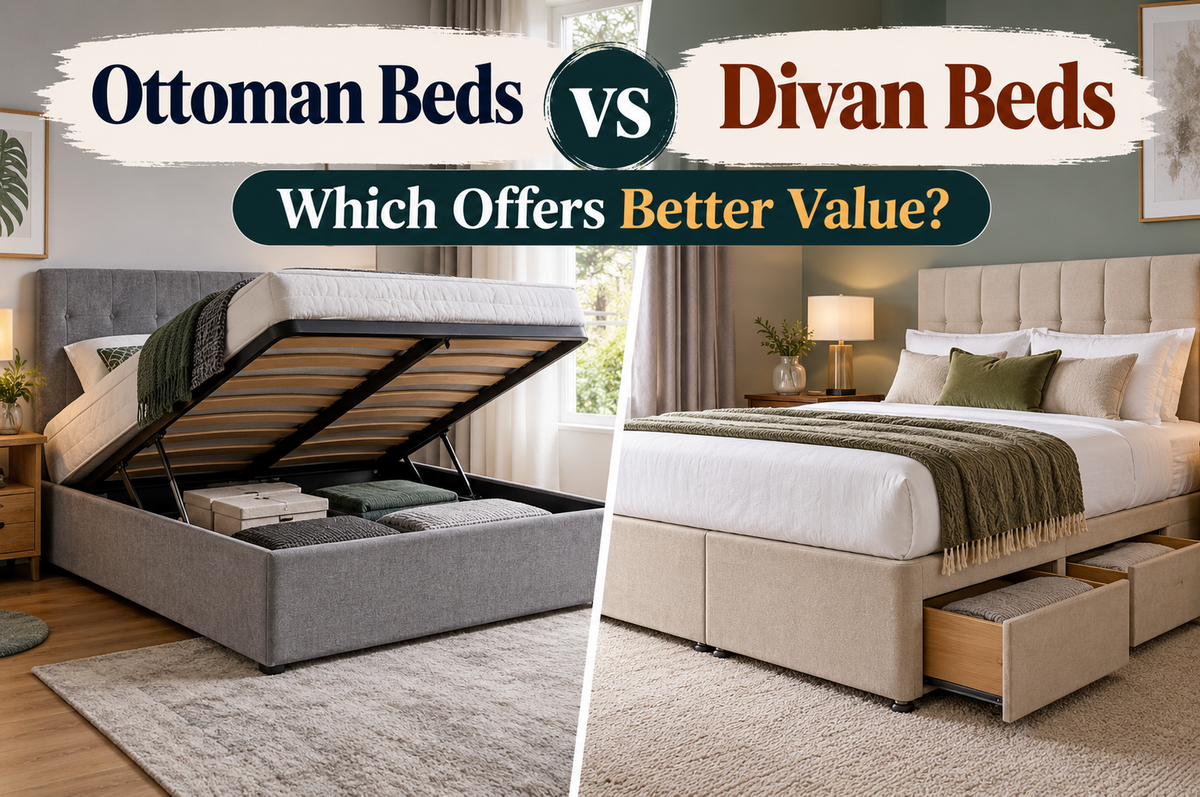
Ottoman Beds vs Divan Beds: Which Offers Better Value?
Choosing between an ottoman and a divan isn't simply a case of asking which bed costs less. Value for money depends on what you get from the space your bed already occupies. Ottoman beds typically make more of the area beneath the mattress by providing a large, hidden storage compartment, while divan beds can offer straightforward drawer storage and a compact, practical base.
The short version: if maximising storage capacity is your priority, an ottoman bed can offer exceptional storage value because almost the entire area beneath the mattress can become usable storage space. If you prefer quick access to smaller belongings and don't need one large storage compartment, a divan bed may make more sense. Purchase price matters, but so do storage access, bedroom size, floor space, durability and how often you'll actually use the storage.
When comparing the two, think about:
-
Storage capacity: ottomans are designed around a large hidden storage area, while divans can be configured with storage drawers.
-
Access: an ottoman requires the mattress platform to be lifted; divan drawers provide direct everyday access.
-
Room layout: drawers need sufficient side or foot-end clearance, whereas an ottoman needs vertical clearance to open.
-
What you're storing: bulky items such as spare bedding and seasonal clothes often suit an ottoman; smaller frequently used belongings can be convenient in drawers.
-
Value: the cheapest purchase price isn't automatically the best long-term value. Consider how much useful storage you're gaining for the bed footprint.
-
Practicality: lifting effort, accessibility, maintenance and the frequency with which you need your belongings all matter.
The key distinction: a divan divides storage into accessible drawers. An ottoman turns a much larger proportion of the bed base into one concealed storage area.
That difference sounds simple. In everyday use, it can completely change which bed feels like the better investment.
What Is the Real Difference Between an Ottoman Bed and a Divan Bed?
Both sit within the broader world of beds, but their approach to storage is fundamentally different.
An ottoman bed uses a lift-up mattress platform to reveal hidden storage inside the base. Rather than pulling storage out into the room, you lift the sleeping platform upwards. This makes the otherwise underused area beneath your mattress accessible without requiring drawers to extend into the surrounding floor space.
A divan bed, by comparison, uses a compact divan base and can incorporate built-in drawers. Instead of opening the whole sleeping platform, you pull individual storage drawers out from the side or end of the base.
This gives us the first meaningful distinction in the ottoman vs divan debate:
| Feature | Ottoman Bed | Divan Bed |
|---|---|---|
| Storage style | Lift-up hidden storage | Built-in drawer storage where fitted |
| Storage access | Beneath mattress platform | Pull-out drawers |
| Best suited to | Bulky or less frequently used belongings | Smaller, regularly accessed belongings |
| Space around bed | Doesn't require drawer pull-out space | Requires drawer clearance |
| Opening space | Needs vertical opening clearance | Needs horizontal drawer clearance |
| Organisation | Large shared compartment | Separate drawer compartments |
| Typical appeal | Maximising storage volume | Simple, convenient access |
Neither system is automatically superior. What matters is how the storage works in your bedroom.
A large storage compartment isn't valuable if you dislike lifting the mattress platform whenever you need something. Equally, easily accessible drawers lose some of their appeal if a bedside cabinet, wall or other bedroom furniture prevents them from opening properly.
That's why comparing divan beds with ottomans purely on purchase price misses much of the picture.
Storage Capacity: Where Ottoman Beds Have an Obvious Advantage
Storage is where the comparison starts to become more interesting.
An ottoman bed is designed to make use of the cavity beneath the sleeping surface. Lift the platform and you're presented with a large area of under-bed storage rather than a handful of separate drawers.
For households short on cupboards, wardrobes or general bedroom storage, that can be extremely useful.
Think about the awkward things that need somewhere to live:
-
spare duvets and pillows;
-
blankets and throws;
-
seasonal clothes;
-
bedding and towels;
-
bags and luggage;
-
shoes in boxes;
-
occasional-use bedroom items.
These aren't always things you need every morning. They are, however, things capable of swallowing an impressive amount of wardrobe space.
A well-planned ottoman bed effectively gives that otherwise dormant area beneath the mattress another job.
The Storage-to-Footprint Question
Here's a more useful way to think about storage value:
How much usable storage are you getting from the floor space the bed already occupies?
Every bed needs a footprint. A double bed occupies roughly the same type of bedroom real estate whether the area beneath it is useful or not. The value question, therefore, isn't merely "Does this bed have storage?" but:
"How efficiently does this bed turn its existing footprint into usable storage?"
This is where storage-to-footprint ratio becomes a helpful concept.
An ottoman's full-base storage can make particularly efficient use of the bed footprint because you aren't restricted to the dimensions of individual drawers. Larger items can occupy the available internal space more flexibly.
With drawer storage, part of the base may remain inaccessible as storage, depending on the particular drawer configuration. Drawers themselves also have fixed dimensions, which naturally determine what will fit inside.
For someone comparing price vs storage capacity, that distinction matters.
A slightly higher upfront cost can still represent better long-term value if the bed solves a genuine storage problem that would otherwise require another chest of drawers, storage boxes or additional bedroom furniture.
But More Storage Doesn't Automatically Mean Better Value
This is where the comparison needs some nuance.
It's tempting to say:
Ottoman = more storage = better bed.
But that's too simplistic.
The amount of storage is only one part of storage value. The other is accessibility.
Imagine you keep pyjamas, chargers, books or everyday clothing beneath your bed. Pulling open a drawer takes seconds. Lifting an entire mattress platform every time you need a small item might feel unnecessary.
Now reverse the situation.
You have a spare king-size duvet, winter bedding, several vacuum bags of seasonal clothes and a suitcase to put away. Trying to divide those bulky items between smaller drawers could become frustrating very quickly. A larger hidden storage compartment makes much more sense.
So the more useful comparison looks like this:
Ottoman storage: high capacity + larger items + less frequent access.
Divan storage: divided storage + smaller items + frequent access.
That doesn't mean either bed must be used that way. It simply highlights why usable storage space matters more than storage volume on paper.
Daily-Use Storage vs Seasonal Storage
One way to decide between them is to divide what you intend to store into two groups.
Daily or weekly-use storage might include clothing, accessories, books and other items you want within easy reach. Drawers can be particularly convenient here because you can access one section without disturbing anything else.
Seasonal or occasional storage might include winter duvets, spare bedding, luggage and clothes that disappear for months at a time. A large ottoman compartment is naturally suited to this sort of bulky storage.
This distinction is especially useful in small bedrooms, where every piece of furniture has to earn its place.
If a storage bed can reduce your dependence on freestanding bedroom furniture, the benefit isn't only additional capacity. You may also gain back valuable floor space, creating a bedroom that feels less crowded.
And that brings us to the part of the comparison that's often overlooked: the space needed to open the storage.
Small Bedrooms: Think Beyond the Bed's Dimensions
Measuring the bed itself is only half the job.
With a divan, you also need to think about drawer clearance. A storage drawer has to travel outwards before you can use it. Position a bedside cabinet too close to the bed and a drawer may not open fully. Put the bed close to a wall and the same problem can occur.
An ottoman approaches the problem differently. Its storage opens upwards rather than spreading into the surrounding floor area.
That can make upholstered beds with thoughtfully designed storage particularly appealing when you're trying to combine comfort, bedroom décor and practical storage without filling the room with additional furniture.
But ottomans have their own spatial consideration: vertical clearance.
The mattress platform needs enough room to rise, and the exact way it opens matters. A side-opening ottoman and an end-opening ottoman can behave quite differently within the same room layout.
This leads to a useful rule:
Don't ask only whether the bed fits. Ask whether the bed's storage can open comfortably once every other piece of furniture is in place.
That single check can prevent a supposedly space-saving bed from becoming surprisingly awkward to live with.
So, Is an Ottoman Bed Better Value Than a Divan?
At this stage of the comparison, the answer depends on what you mean by value.
If value means the lowest initial cost, your priorities may point in one direction.
If value means maximum hidden storage for the floor space occupied by the bed, the calculation changes.
And if value means easy everyday access to organised storage, it changes again.
A better way to judge ottoman beds vs divan beds is therefore to split value into four categories:
-
Purchase value — what are you getting for the upfront cost?
-
Storage value — how much genuinely usable storage space do you gain?
-
Space value — how efficiently does the bed work within your room layout?
-
Long-term value — will the design, storage system and practicality continue to suit you over time?
The purchase price is only the beginning.
Next, those four measures need to be tested against the features that make the biggest difference in daily life: gas-lift mechanisms, drawer configurations, accessibility, comfort and support, durability, maintenance and long-term ownership costs.
Gas-Lift Storage vs Drawers: Which Is Easier to Live With?
Storage capacity is important. Storage access is what you'll notice every day.
The defining feature of most ottoman storage beds is the lift mechanism. Rather than reaching beneath the bed or pulling out individual drawers, the mattress platform rises to expose the storage compartment underneath.
A gas-lift system assists with that movement, reducing the lifting effort required compared with simply trying to raise the weight of the mattress and platform yourself. Depending on the particular design, an ottoman may open from the side or from the foot end.
Divan storage is considerably more straightforward: pull a drawer out, retrieve what you need, push it closed.
That simplicity can be valuable.
If you regularly need access to socks, bedding, clothes or smaller bedroom essentials, built-in drawers let you reach one compartment without opening the rest of the bed. There's no mattress platform to raise and no large storage cavity to organise.
The trade-off is capacity and flexibility.
A drawer has fixed dimensions. An ottoman compartment gives you a much larger area in which differently shaped belongings can be arranged.
When a Gas-Lift Ottoman Makes More Sense
A lift-up design becomes particularly useful when your priority is to maximise storage rather than access lots of little things throughout the day.
It can work well for:
-
spare bedding and duvets;
-
pillows and blankets;
-
vacuum-packed seasonal clothes;
-
shoe boxes;
-
bags and suitcases;
-
items you want stored out of sight;
-
belongings you only retrieve occasionally.
The absence of pull-out drawers can also be advantageous where the sides of a bed sit close to other furniture.
In a compact bedroom, for example, you might have just enough room for a bedside table next to the bed. A conventional storage drawer could compete for exactly the same floor space. Lift-up storage avoids that particular conflict.
When Divan Drawers Make More Sense
The equation changes if everyday convenience matters more than maximum storage volume.
You don't have to expose an entire storage compartment to retrieve one T-shirt from a drawer. There's also no need to lift the mattress platform whenever you want something.
This makes a divan base with storage drawers particularly practical when the items beneath your bed are part of your normal routine rather than belongings being packed away for another season.
The important thing is choosing an appropriate drawer configuration.
Before buying, look at where your wardrobes, bedside furniture, radiators and walls sit. Then consider whether each pull-out drawer would have sufficient clearance.
A drawer you can't fully open has very little storage value, regardless of how useful it looked on a product page.
Accessibility: An Important Part of Value That's Easy to Miss
Storage isn't genuinely useful if accessing it is uncomfortable.
That makes ease of use an important consideration when comparing a divan bed vs ottoman bed, particularly for anyone with limited mobility or who simply wants the least physically demanding storage arrangement.
Gas-assisted mechanisms are designed to make opening an ottoman easier, but the user still interacts with a lifting system. The experience will vary according to the particular bed, mechanism and mattress being used.
A drawer is different. It moves horizontally rather than requiring the sleeping platform to be raised.
However, that doesn't automatically make drawers the more accessible solution in every situation.
Low drawers may require bending or crouching. Deep drawers can become heavy when filled. Furniture can restrict how far they open. And reaching belongings at the back isn't always as effortless as it appears.
So accessibility should be considered personally.
Ask yourself:
-
Can I comfortably operate the storage mechanism?
-
Will I be accessing it every day or a few times a year?
-
Can I reach the stored items comfortably?
-
Will surrounding furniture obstruct access?
-
Am I likely to fill the storage with heavy belongings?
These questions are more useful than assuming one storage design is universally easier.
Purchase Price vs Long-Term Value
Price naturally influences any comparison of ottoman beds vs divan beds, but the cheapest option at checkout isn't necessarily the most cost-effective bed over time.
Suppose one bed costs less but provides very little usable bedroom storage. If you subsequently need to buy another chest of drawers or storage unit, the original saving begins to look less significant.
The reverse can also be true.
Paying for a large storage compartment you barely use isn't particularly good value either.
This is why the best value bed isn't necessarily the cheapest bed or the bed with the biggest storage capacity. It's the one whose features replace a genuine need in your bedroom.
A useful way to think about it is:
Bed value = sleeping function + useful storage + space efficiency + everyday practicality + longevity
Not every household will give those factors equal weight.
Someone furnishing a large bedroom with ample wardrobes might care relatively little about under-bed storage. Someone trying to make a small bedroom work without adding another bulky piece of furniture may place a much higher value on it.
Think About Cost Per Usable Storage Space
There's an important word there: usable.
Raw storage volume can sound impressive, but the real question is how much of that space works for the things you own.
For example, imagine two storage systems:
-
one provides several smaller, easily accessed compartments;
-
another provides one substantially larger open compartment.
The first may provide greater organisational convenience. The second may offer greater flexibility for bulky items.
Neither advantage can be captured properly by purchase price alone.
When comparing storage beds, consider the price-to-storage relationship, but also ask what proportion of that storage you'll realistically use.
For a household trying to reduce clutter, free wardrobe space and keep seasonal belongings out of sight, a large hidden compartment can have significant practical value.
For someone who mainly wants somewhere convenient to put a few frequently used items, additional capacity might be unnecessary.
Better value isn't about getting the most storage at any cost. It's about paying for storage you'll actually use.
Could a Storage Bed Save You From Buying More Furniture?
This is where space value enters the equation.
A bed and a freestanding chest of drawers occupy two areas of floor space. A bed that incorporates sufficient storage may allow some households to reduce the amount of additional furniture they need.
That can be especially valuable in compact bedrooms.
Removing unnecessary furniture can:
-
create clearer walking routes;
-
make the room feel less crowded;
-
free space around wardrobes and doors;
-
improve bedroom organisation;
-
reduce visible clutter;
-
make better use of otherwise dormant space beneath the mattress.
In that sense, a space-saving bed isn't necessarily a physically smaller bed. It can simply be a bed that makes its existing footprint work harder.
This is one of the strongest arguments for judging value beyond the initial cost.
A storage solution that helps create a more functional, clutter-free bedroom provides a benefit every day, not just when you first buy it.
Comfort and Support Still Come First
There's a danger when comparing storage beds of becoming so interested in hinges and drawers that we forget why the furniture exists in the first place.
It's a bed. You have to sleep on it.
Storage should complement the sleeping experience, not overshadow it.
When comparing different bed designs, consider the complete combination of the bed base and mattress rather than treating storage capacity as the only meaningful specification.
Factors such as mattress support, mattress compatibility, base construction and comfort deserve just as much attention because you'll experience them every night.
Different bed designs can use different supporting structures, so don't assume that every ottoman has exactly the same type of base or that every divan is identical. Specifications should be checked on the individual model you're considering.
The same applies to mattresses.
A mattress needs to be appropriate for the bed on which it is used, and with a lift-up design, the relationship between the mattress and lifting mechanism is particularly relevant. The individual product's requirements should always take priority over general assumptions about ottoman beds.
Ultimately, enormous storage capacity is poor compensation for a sleeping setup that doesn't meet your comfort needs.
Storage Value Should Never Trump Sleep Quality
A useful buying hierarchy is:
-
Choose a bed and mattress combination that meets your sleeping needs.
-
Make sure its dimensions suit the bedroom.
-
Decide how much storage you genuinely require.
-
Consider how frequently that storage will be accessed.
-
Then compare price and long-term value.
This keeps the priorities in the right order.
A bed is likely to be used every night. Its storage may be opened far less often.
Durability: Does a Simpler Bed Mean Better Long-Term Value?
Long-term value also depends on bed construction and durability.
A storage system introduces functional components beyond the basic structure of a bed.
An ottoman uses moving parts as part of its opening system. Depending on its design, these can include a gas-lift mechanism, hinges and associated hardware. A divan with drawers has runners and the drawers themselves, but doesn't require the entire mattress platform to lift.
This doesn't mean one design is inherently durable and the other isn't.
It means there are different components to consider.
When shopping, it's worth paying attention to:
-
construction quality;
-
the design of the storage mechanism;
-
maximum recommended loads where specified;
-
mattress requirements;
-
storage weight limits where provided;
-
warranty information;
-
care requirements;
-
assembly instructions.
For an ottoman in particular, mechanism durability matters because easy storage access depends on that lifting system continuing to operate correctly.
For a divan, the construction and smooth operation of the drawers become important if they're being opened several times every day.
What About Maintenance?
A simple storage arrangement can have an advantage: fewer mechanisms may mean fewer functional components to think about.
But maintenance shouldn't be exaggerated into a reason to avoid storage beds altogether.
Instead, treat it as one element of total cost of ownership.
If you're assessing long-term value, don't stop at the price displayed today. Think about how the bed will be used over the years:
-
How often will the storage be opened?
-
Are the moving components designed for regular use?
-
Is the bed straightforward to care for?
-
What does the warranty cover?
-
Are there any weight or usage restrictions?
-
Will the storage arrangement still suit you if your circumstances change?
That last question is particularly important.
Beds are long-term purchases. Your storage needs in a year's time may not look exactly like they do today.
Style Matters Too — Because Practical Doesn't Have to Mean Boring
Storage is functional, but your bed is also usually the largest piece of furniture in the bedroom.
It has an outsized influence on the room's appearance.
Upholstery, fabrics and finishes, headboard design, proportions and the overall silhouette can all affect whether a bed complements your bedroom décor.
This matters when discussing value because buying furniture you genuinely like—and will continue to like—can be more sensible than choosing purely on storage specifications.
A highly practical bed that you want to replace because it doesn't suit your room isn't necessarily a good long-term investment.
Likewise, a beautiful bed that leaves you fighting bedroom clutter every day hasn't fully solved the practical problem.
The sweet spot is where aesthetics, storage efficiency, comfort and practicality meet.
And this brings the comparison to its most useful point: rather than asking whether ottoman beds or divan beds are universally better, we can now identify which type offers better value for different bedrooms, budgets and storage habits.
Which Offers Better Value for Your Bedroom?
By now, one thing should be clear: there isn't a single definition of value that works for every bedroom.
The right question isn't simply, "Which bed is cheaper?"
It's:
"Which bed gives me the most useful combination of sleep, storage, space efficiency and everyday convenience for the money I'm spending?"
Once you look at it that way, choosing between an ottoman and a divan becomes much easier.
Choose an Ottoman Bed If You Need Maximum Storage
An ottoman is particularly compelling when storage capacity sits near the top of your priority list.
Because the mattress platform lifts to reveal the compartment beneath, the design can turn a substantial portion of the bed footprint into hidden storage. That's valuable if your wardrobes are already full, cupboard space is limited or you simply want somewhere discreet to put bulky belongings.
An ottoman may therefore suit you if:
-
you have a small or compact bedroom;
-
you want to maximise bedroom space;
-
you regularly store bulky bedding;
-
you have seasonal clothes to put away;
-
you need space for luggage or larger items;
-
there's insufficient clearance for conventional drawers;
-
you prefer concealed storage;
-
you're trying to reduce the amount of freestanding furniture in the room.
For these households, paying more upfront for greater storage capacity can make financial and practical sense.
The bed isn't simply somewhere to sleep. It's performing two jobs within essentially the same footprint.
That can translate into excellent storage value.
Choose a Divan Bed If Convenient Access Matters More
A divan becomes particularly attractive when you value simple, compartmentalised storage.
Rather than lifting the sleeping platform, you can open the relevant drawer and retrieve what you need.
That can be ideal for smaller belongings that are used regularly.
A divan may suit you if:
-
you prefer pull-out storage drawers;
-
you want quick access to stored belongings;
-
you don't need one large storage compartment;
-
your room has adequate drawer clearance;
-
you prefer keeping different items separated;
-
you want a straightforward storage arrangement;
-
you're working to a tighter initial budget.
The last point matters.
If you don't actually need the additional storage volume an ottoman provides, paying extra for it doesn't automatically represent better value for money.
Unused storage has no practical value.
Ottoman Bed Pros and Cons
The strengths of an ottoman become most obvious when bedroom storage is limited.
Advantages of an Ottoman Bed
Generous hidden storage
The principal benefit is straightforward: the area beneath the mattress can become a substantial storage compartment.
Excellent for bulky items
Spare bedding, duvets, blankets, bags and seasonal clothing are generally easier to accommodate in a large open storage area than in smaller drawers.
Efficient use of the bed footprint
The storage occupies space the bed already needs, which can improve floor-space efficiency.
No pull-out drawer clearance required
Because the storage opens upwards, you don't need to reserve floor space beside the bed for drawers to extend into.
Helps reduce visible clutter
Items disappear beneath the mattress rather than remaining in boxes or taking up space elsewhere in the bedroom.
Disadvantages of an Ottoman Bed
The storage has to be lifted open
Even with an assisted lift mechanism, accessing an ottoman is a different physical action from opening a drawer.
Less convenient for tiny everyday items
Opening the storage compartment every time you want one small item may not be the most practical arrangement.
Moving parts require consideration
Hinges and lifting components form part of the design, so construction quality and correct use matter.
Organisation requires thought
One large compartment offers flexibility, but without sensible organisation it can become a place where smaller belongings disappear beneath larger ones.
It may have a higher initial cost
Depending on the beds being compared, the additional storage mechanism and construction can influence purchase price.
The important point is that these ottoman bed pros and cons are connected.
The same large compartment that makes an ottoman brilliant for bulky belongings can make it less convenient for a handful of small items you need twice a day.
Divan Bed Pros and Cons
Divans solve the storage problem differently.
Advantages of a Divan Bed
Easy access to individual drawers
There's no need to open the whole bed to retrieve one item.
Built-in organisation
Separate drawers naturally divide belongings into smaller groups.
Useful for frequently accessed items
Everyday access can be quick and straightforward where sufficient clearance is available.
Compact overall design
A divan base can provide a neat foundation without requiring a large external bed frame.
Potentially lower upfront cost
Depending on the models and specifications being compared, a divan can provide a budget-friendly route to a practical bed.
Disadvantages of a Divan Bed
Drawer clearance is essential
A drawer that collides with a bedside table or wall becomes considerably less useful.
Storage is divided into fixed spaces
Drawer dimensions determine what you can store.
Bulky belongings can be awkward
Large duvets, suitcases and similarly substantial items may be harder to accommodate than in an open ottoman compartment.
Not all of the base necessarily becomes storage
The amount of usable storage depends on the specific configuration.
Again, these aren't necessarily flaws. They're trade-offs.
A shopper who wants somewhere convenient for folded clothes might see individual drawers as an advantage. Someone trying to hide two large duvets and several bags might see those same drawer dimensions as a restriction.
Which Bed Is Better for a Small Bedroom?
This is one situation where looking purely at external bed dimensions can be misleading.
In a small bedroom, storage efficiency and access space matter almost as much as the dimensions of the bed itself.
An ottoman can be especially useful when there isn't sufficient room around the sides of the bed for drawers to open comfortably.
Instead of extending into your available walking space, the storage opens vertically.
That's a significant advantage where:
-
the bed sits close to a wall;
-
bedside tables occupy the available side space;
-
a wardrobe is positioned near the bed;
-
walking clearance is already tight;
-
there's little room for additional storage furniture.
But don't automatically assume that every small bedroom needs an ottoman.
If the room layout provides plenty of drawer clearance and you only require modest storage, a divan can still work extremely well.
The goal is small bedroom storage that actually functions within the room, not simply the bed with the largest theoretical capacity.
Measure the Storage, Not Just the Mattress
Before choosing either design, measure:
-
the available width and length for the bed;
-
the walking space around it;
-
the distance to bedside furniture;
-
clearance from wardrobes and doors;
-
the area required to access the storage.
Then consider the internal storage dimensions supplied for the particular bed you're considering.
This turns a vague comparison into a practical one.
Are Ottoman Beds Worth the Money?
For someone who will genuinely use the storage, an ottoman can provide substantial practical value.
The important qualification is use.
If an ottoman enables you to store bulky belongings without adding another piece of bedroom furniture, the additional storage can be valuable every day. If it allows you to reclaim wardrobe space, keep seasonal items organised or create a less cluttered bedroom, you're receiving more than a large box beneath your mattress.
You're buying greater storage efficiency from space the bed was going to occupy anyway.
On the other hand, if you already have ample wardrobes and cupboards and don't expect to use much under-bed storage, paying specifically for maximum storage capacity may be unnecessary.
So rather than asking only, "Are ottoman beds worth the money?", ask:
"How much would I actually value the storage beneath my bed?"
If the answer is "a lot", an ottoman becomes much easier to justify.
Are Divan Beds Worth It?
Absolutely—for the right storage habits.
A divan shouldn't be treated as merely the alternative you choose when you don't buy an ottoman.
Its storage system solves a different problem.
If you want quick, separated, easy-to-understand storage, drawers can be more useful than one large compartment. You can dedicate one drawer to bedding, another to clothes and another to accessories without having to organise a large shared cavity.
And if storage isn't your main priority, a divan can still provide a practical bed base without paying for capacity you don't require.
Again, value is personal.
The better purchase is the one whose features you actually use.
What About Adjustable and Electric Beds?
There's another category worth mentioning because not every shopper's priorities revolve around storage.
If adjustability, positioning or assisted movement is more important than maximising under-bed capacity, it's worth considering electric beds separately rather than trying to make an ottoman or conventional divan solve a different requirement.
This illustrates a broader point about buying a bed.
Start with the problem you need the bed to solve.
For one household, that's a lack of storage.
For another, it's everyday accessibility.
For someone else, comfort or adjustability comes first.
Once the primary need is clear, value becomes much easier to judge.
Ottoman vs Divan: A Value-for-Money Comparison
Here's the comparison distilled into the factors that matter most:
| Priority | Ottoman Bed | Divan Bed |
|---|---|---|
| Maximum storage capacity | Strong choice | Depends on drawer configuration |
| Bulky-item storage | Particularly useful | More restricted by drawer dimensions |
| Everyday storage access | Requires opening the bed | Convenient drawer access |
| Hidden storage | Excellent | Good where drawers are fitted |
| Small-item organisation | Requires organisation inside compartment | Naturally divided |
| Drawer clearance | Not required | Required |
| Vertical opening clearance | Required | Not normally relevant to drawer access |
| Small-bedroom potential | Strong where side space is restricted | Strong where drawer clearance is available |
| Seasonal storage | Particularly useful | Suitable depending on item size |
| Initial budget | Compare individual models | Can suit budget-conscious shoppers |
| Long-term value | High when large storage is genuinely useful | High when accessible storage matches your needs |
The winner changes depending on the priority.
And that's precisely why purchase price alone is such a poor measure of value.
How to Choose Between an Ottoman and a Divan
If you're still undecided, work through this checklist before buying.
1. Decide What You're Actually Storing
Don't simply tell yourself you "need more storage."
Make a rough list.
If it includes duvets, luggage, blankets and bags, a large compartment becomes attractive.
If it consists mostly of folded clothes and smaller everyday belongings, drawers may be more convenient.
2. Decide How Often You'll Need It
Items used twice a year don't need instant access.
Items used twice a day probably do.
Frequency of access should influence storage design.
3. Measure the Room
Don't stop at the mattress dimensions.
Check drawer clearance, surrounding furniture, doors, wardrobes and the space needed to operate the storage.
4. Consider Accessibility
Think realistically about bending, pulling drawers and lifting the sleeping platform.
The best storage mechanism is the one you're comfortable using.
5. Check the Individual Bed Specification
Look at construction, dimensions, mattress requirements, storage guidance and any weight limits specified for the particular model.
Don't rely on assumptions about an entire category of beds.
6. Consider What Other Furniture the Storage Could Replace
If a larger storage bed means you no longer need another chest or storage unit, include that in your value calculation.
7. Think Beyond Today's Purchase Price
Consider durability, everyday practicality, maintenance and whether the storage arrangement will continue to suit your household.
That's a far better test of long-term value.
Final Verdict: Ottoman Bed or Divan Bed?
For maximum storage capacity, bulky belongings and efficient use of the area beneath the mattress, an ottoman has clear practical strengths. Its large concealed compartment can be particularly valuable in small bedrooms and homes where conventional storage is limited.
For quick everyday access, separated storage and straightforward organisation, a divan with drawers has equally clear advantages. If you don't require maximum storage volume, paying for it simply because it's available may not represent good value.
So, Ottoman Beds vs Divan Beds: Which Offers Better Value?
The answer depends on what you're buying the storage for.
Choose based on four things:
purchase value + storage value + space value + long-term value.
If storage capacity and floor-space efficiency carry the greatest weight, an ottoman deserves serious consideration.
If frequent access, drawer organisation and simplicity matter more, a divan may better fit the way you actually live.
Neither bed offers better value simply by belonging to a particular category.
The better-value bed is the one that makes the space you already have work harder without making everyday life harder in return.
Frequently Asked Questions
Which has more storage, an ottoman bed or a divan bed?
Ottoman beds are designed around a large storage compartment beneath the mattress platform, while divan storage is typically divided into drawers. The exact amount of storage varies between individual models, so compare the specifications and internal dimensions of the beds you're considering rather than assuming every bed is identical.
Which storage bed is best for a small bedroom?
It depends on the room layout. An ottoman can be useful where there isn't enough side space for drawers to extend into the room. A divan can work equally well if the drawers have sufficient clearance. Measure the bed and the space required to access its storage.
Are ottoman beds good for storing suitcases?
A large open storage compartment can make an ottoman particularly useful for bulky items such as bags, bedding and some luggage, subject to the dimensions and storage guidance of the individual bed.
What should you store in a divan bed?
Drawer storage can be particularly convenient for smaller belongings you want organised and readily accessible, such as bedding, clothing and bedroom accessories. What you can safely store will depend on the dimensions and guidance for the specific bed.
Is an ottoman difficult to lift?
Ottoman beds commonly use an assisted lifting mechanism designed to help raise the mattress platform. Ease of operation varies between designs and can also depend on the mattress and correct assembly, so check the specifications and instructions for the model you're considering.
Do ottoman beds need space around them to open?
They need appropriate clearance for the mattress platform to lift. Unlike pull-out drawers, however, they don't require the same horizontal drawer clearance beside the bed. Consider whether a side-opening or end-opening design best suits your room layout.
Are divan beds better for everyday storage?
Drawers can be especially convenient for belongings accessed regularly because you can open an individual compartment without lifting the sleeping platform. Whether that's better for you depends on what you're storing and whether the room provides sufficient drawer clearance.
Does an ottoman bed need more maintenance than a divan?
The two designs contain different functional components. An ottoman has a lifting mechanism and hinges, while a storage divan can have drawers and runners. Rather than assuming one requires more maintenance, check the construction, care instructions and warranty information for the specific bed.
What makes a storage bed good value for money?
Look beyond the purchase price. Consider usable storage capacity, ease of access, floor-space efficiency, comfort, durability and how frequently you'll use the storage. Storage that solves a genuine problem is more valuable than additional capacity that remains empty.
Should I choose storage capacity or convenience?
Think about what will be stored and how often you'll retrieve it. Large or seasonal belongings can favour spacious hidden storage, while frequently accessed smaller items can favour divided drawer storage.
Can a storage bed make a bedroom feel less cluttered?
It can. Moving belongings into under-bed storage may reduce the need for visible boxes or additional storage furniture. The effect depends on how much storage you require and how effectively you organise the space.
Is the cheapest bed always the best value?
No. Purchase price is only one part of the calculation. A bed that costs more initially but provides storage or functionality you genuinely need may offer stronger long-term value. Equally, paying extra for features you won't use isn't automatically worthwhile.
The Bottom Line
Beds take up a substantial amount of bedroom space. The smartest designs make that space work harder.
An ottoman does it by turning the area beneath your mattress into a large hidden compartment.
A storage divan does it by putting organised, accessible drawers into the base.
Which one represents better value isn't determined by the biggest storage figure or the smallest price tag.
It's determined by your room, your belongings, your budget and the way you intend to use the bed every day.
Get those four things right, and the decision between ottoman and divan becomes considerably simpler.